Showing posts with label BioDiesel Hauling. Show all posts

Friday, 8 March 2013

summer project

I did everything from drawing the blueprints to pouring the concrete footings. The door initially opened directly on to the staircase, which I simply removed, and then reattached after the deck was finished. Took about 2 weeks (half of which was shopping time, and waiting for the concrete to dry), and cost just under $2000 (not including materials)


.


Wednesday, 2 May 2012

Jacob Aziza / Bakari Kafele; Ecomodder / Hypermiler

Jacob Aziza / Bakari Kafele; Ecomodder / Hypermiler

by Bakari Kafele on May 2, 2012
Good morning fellow ecomodders, hypermilers, and efficiency enthusiasts of all kinds.
The EcoModder blog has been inactive for over a year (save Tim’s two most recent updates), and I have been asked to help pick it up again.
So, since I also have not been active on this site for nearly a year, to start I thought I would re-introduce my self:
My name is Bakari Kafele.  My internet screen name (or at least one of them) is Jacob Aziza.
You may remember me from such internet sites as the EcoModder Forum and Instructables.com
I have an old (1983) full-size truck with a 6.9L diesel V8 that I use for deliveries and hauling and occasionally towing.  It would be a monstrosity for a commuter vehicle, but it’s about the smallest thing that could serve my work needs – most people hauling large or heavy loads (see below) would use a box truck, a flat bed, or maybe even a dump truck.


At the very least an F-350 or equivalent1-ton pick-up.
So, depending on how you look at it, getting 15 miles per gallon, (as I was five years ago), could be considered decent, given the type of work being asked of this old truck – 15 mpg being what I measured I was getting, which coincided more or less with what most people report getting in the same make model and year truck.
Then, in 2008, I read an article about Wayne Gerdes…


I found it to be revolutionary and inspirational.  It was one of those moments where it seemed like the idea should have been glaringly obvious all along, and yet somehow never occurred to me.  Slow down, accelerate with moderation, coast early instead of braking last minute.  Obvious stuff, right?
While I had always been environmentally conscious (I was running the truck on biodiesel most of the time,  and my personal transportation was – and is – mostly done by bicycle), I had also been a speed enthusiast in my youth.  The only reason I gave up on casual street racing, drifting, and other performance and trick driving in my Honda Civic was that I totaled it when I attempted to take a tight turn (the sign recommended 20MPH) at 55MPH.
I never put two and two together; never recognized the direct correlation between driving habits and resource consumption.
After reading the article, my driving habits underwent a 180 degree turn.
Despite having once received a letter from the DMV warning me that I was one point away from a suspended license, I now started driving below the speed limit, anticipating stops, and even coasting.
And after a few months, I was pulled over by the CA Highway Patrol once again.
Not that driving 50MPH on a 65MPH highway is actually illegal in CA; but because EVERYONE speeds here, all the time, the officer assumed I must be intoxicated to actually drive below the speed limit.  When I passed the breathalyzer, I was free to go.
I found that to be a (tragically) funny thing – I am surrounded by people breaking the law.  I am the one person NOT breaking the law.  And I am the one who gets stopped by law enforcement, because it is suspicious that I am not breaking the law like everyone else.  I thought that would be an interesting story to share, especially with people who were also trying to get the best possible fuel mileage from their own vehicles.
So I went online, and tried to find out if there were any discussion boards specifically dedicated to this “hypermiling” thing.
And that’s how I discovered:  EcoModder.com
Wow.  A whole new level.  Not only were there dozens of more in-depth secrets to driving technique, but people were actually modding their cars – not to make them faster or look cooler – but to actually make them more efficient.  Revolutionary, mind-blowing, and in the end as it turned out, life changing.
I won’t chronicle the entire process here, because I already did in the forums, as it was happening.
During this process a friend of mine (and fellow mechanic at the bikeshop I work at) convinced me to write about my truck mods for Instructables.com.
They happened to be doing an energy efficiency contest at the time, which I entered and took second place in, winning a T-shirt!
But even better, the founder and CEO of the company noticed my contest entry, and personally hired me to do a little work at his home.  How cool is that?
Throughout this time period, I had also been writing my own personal blog, and one of the founders of faircompanies.com, Kirsten Dirksen, happened to run across my article on anthropogenic global warming, in which I argue that the evidence is still inconclusive, but we should be acting as though it is true regardless of what science eventually finds.  She asked if I would post some of my content on their website, which I began doing.
About a year or so later she emailed me saying they were taking a trip to the US (from Spain) and asking if I would be willing to be interviewed on camera.
I was still new to hypermiling and hadn’t started ecomodding when the video was taken, so while I did mention driving the smallest vehicle that meets ones needs, fuel efficiency, and bicycles, the portion on my small home got most of the attention.
As my ecomodding habit began, since I was already posting eco related content to the Faircompanies website, Kirsten followed the development of the truck, and its transition from 15mpg to up to 30mpg. The next time she came to the US, several years later, she requested a follow up interview – and the new video which came out recently is all about hypermiling and ecomodding.

That brings us to today.
I recently looked into replacing the rear differential, as was suggested to me in the forums, but it turns out the 2.73  and 3.08 were never made for the stronger 8 lug / F-250+ wheels.  So I’m back to wanting to replace the transmission with one that has overdrive to lower my highway RPMs, but I haven’t found a diesel ZF with the granny gear yet.
I’ve been getting slightly lower mileage than my peak, just over 25 miles per gallon over the past 6 months, VS 29MPG average over the 6 months before that – but still a whole lot better than the 15MPG I started out at.
Inline image 1
I suspect this is mostly due to having re-installed the alternator after my onboard 120v charger died, and being lazy about pulse and glide (as in, not doing it at all).
Between the video coming out and writing here, I’ve been more motivated to get my mpgs back up.
I’ll let you know how that goes.
UPDATE – I recently replaced all four tires with the General Grabber HTS, which is one of only two brands that is supposedly low rolling resistance in a tire with a 120 load rating.  I have only had them on about a week, so its too soon to say if/how much they will help (they are replacing on/off road tires in back, and dangerously worn road tires in front) – but what I can say is that the first time I drove with them fully inflated (the shop of course only inflated to 50 – even though I specifically asked them to go to the sidewall max of 80PSI) it was so easy to turn the (manual) steering wheel that for a split second I actually thought there might be something wrong.  I had gotten used to the old tires, and these ones turn with so little resistance that it feels like power assist by comparison.  That feels like a good sign to me.
I also just received my new battery charger (yesterday!) so I can take the alternator belt back off.  Between the two, I’m hoping to hit my 5th 30+mpg tank average – and then keep it there.  We’ll see…

Tuesday, 27 April 2010

Response to "Turning Hustlers into Entrepreneurs"


·         Apr 27, 2010

Response to "Turning Hustlers into Entrepreneurs"

"Turning-Hustlers-into-..Entrepreneurs" discusses the possibility of increasing micro-credit in order to support independent "black market" business people.  As someone who has been running a successful off-the-books business for several years, I believe the major obstacle is not a lack of credit, but rather a government which is geared toward big business.
As the examples in the article illustrate, people are already doing what they are doing, without capital.  What they lack is official legitimacy.  Many entrepreneurs, such as myself, would love to "go legit", but it is not a realistic option.
I understand and support the idea that government regulate business to protect consumers.  The problem is that government does not take the size of a business into account in the requirements it imposes on operating legally.

For example, a single guy with a pick-up truck doing local deliveries pays the exact same state license fee as a company with a fleet of semi trucks.  The  least insurance available to him is a million dollars of coverage with a 1-2 thousand dollar annual premium, even if he never comes close to transporting a million dollars worth of goods.   Every city he works in requires its own separate business license.  If he needs to hire a subcontractor on occasion, he needs to buy worker's comp insurance at a minimum, and possibly more.  Being self-employed, he pays an additional tax (which an employer would otherwise cover).  And of course by staying underground, he avoids paying any income tax on his business revenue.

All of this can easily add up to thousands of dollars.  That sum may be inconsequential to a corporation with annual sales in the millions of dollars, but to a small independent, going legit would cost me about 20% of my entire net revenue, more than two months income.

The solution to this is not to finance small business to help them pay for theses fees - these fees are annual, and taking loans only increases risk.  The solution is to have license fees proportional to net revenue, instead of being fixed amounts, requiring insurance companies to offer a full range of coverage options, including (potentially less profitable) low limit policies, and restructuring tax code so there isn't a penalty to being self-employed. Similarly, laws making it difficult or illegal to run certain types of business from home could be relaxed, (for example, allowing small scale retail in otherwise residential districts), eliminating the need for a dedicated store-front, a major on-going expense.

Reducing the government imposed costs of running an independent business legally would, without the additional risk incurred (for both the investor and the entrepreneur) by accepting loans or the costs incurred by providing grants.  It would also increase tax revenue, by encouraging existing underground businesses to come above the radar and join the mainstream economy.

Sunday, 24 January 2010

Micheal Scott has it right


  • Jan 24, 2010

Micheal Scott has it right

On the popular TV show "The Office", the branch manager is a bit of a doofus.  He's not all that bright, he is totally obsessed with having his employees like him on a personal level, and he has very little knowledge of actual business or management theory.
He makes his superiors wring their hands and shake their heads - but the thing is, his office's sales record is the best in the company, so despite his many, many faux pax, he always keeps his job.

Nobody can quite figure out how he manages to do such a good job in spite of himself.

Even though he tells them quite clearly, time and again.

He considers his employees family.
He wants his customers to feel cared for.
He is more interested in making people happy than in making money.

You can't learn to be community based and to value clients as actual people in business school.  You can't use the idea of caring about people and being friendly to increase the bottom line, because if your interest is in the bottom line, you aren't genuinely interested in people.  You can't fake authenticity. 


Its either about the love, or its about money. Once you start thinking about rate of return ratios, receivables balance fractions, risk-adjusted profitability, or marginal value-added pricing structures, and all the other things one learns in business school, you are far beyond the point of seeing every person you work for and every person you work with as numbers.

From there it is a very slippery slope to the scenario described by "Jack" in Fight Club: If the cost of the average rate of settlement times the expected rate of failure is less than the cost of a recall for a known deadly manufacturing error, we don't do the recall.
In the end it comes down to morality.  Its either being moral, or maximizing profit.  They are mutually exclusive.

No business is going to have as their slogan "All we care about is your money", and a lot of them try in ads to sound like it isn't true; for any public corporation it is actually illegal for them to consider anything else above the bottom line - if they tried the shareholders could sue. 
For the vast majority of companies jumping on the band wagon, being environmentally responsible is a marketing gimmick as much as a catchy jingle.

Thinking in terms of doing productive work for society while earning fair compensation, as opposed to thinking of how to maximize revenue while minimizing costs will not (always) lead to the highest possible profits.

It will, I think, mean that business actually increases while the rest of the country is in an economic downturn.  It means getting so many referrals its necessary to turn jobs down after going a year and a half without any form of advertising.  It means when, inevitably, mistakes are made, no customer ever makes a claim, because they realize they are not just numbers, that every attempt to be careful was made, all actions in good faith. 
It means that quite a few of my customers make me meals while I'm working.

If a job is a paycheck, it will show through to the customer, no matter how you try to hide it.
If I am ever in a position to hire anyone, my first question will not be about education or experience or abilities or references.  My first and most important question is just this: Why do you want the job?  If its about pay and benefits, no matter how qualified, its "next please".

It has to be about the love.

Sunday, 22 November 2009

THERE IS SO MUCH TO LEARN


  • Nov 22, 2009

THERE IS SO MUCH TO LEARN

I have not been writing much lately.

Spending my time with work, and new friends, and classes.

Work remains fun, after 3 years of doing the same things (compare to a record of 10 months max at any one job for the rest of my life prior), easy enough to be good at it, challenging enough to stay interesting. 
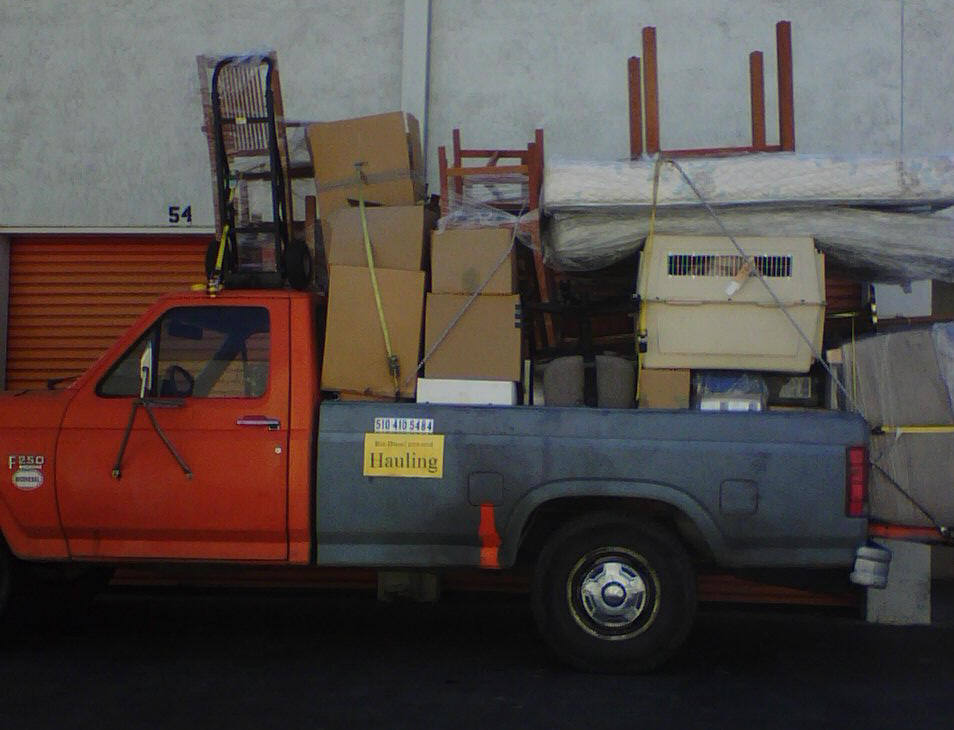
Just the past few days involved somehow fitting about 10cubic yards of random stuff into the truck for the largest hauling run I've had so far, installing drywall in an attic furnace room so the building could pass fire inspection, and careful deconstuction of the walls holding in the old biodiesel tanks at the old biodiesel fuel station so the lumber could be reused.

But far more important and interesting is the classes.

Little by little I add to my stable of random skills.


Expert in nothing, but my goal is for everyone there is, I can do at least one thing moderately well that they don't do at all. 
Maybe there is someone who does a little carpentry and electronics soldering and computer software troubleshooting and lockpicking and sailing and shooting guns and bow and arrows and swordplay and bicycle repair and auto mechanics and unicycling and gardening.
Just in case, I'm taking muy thai and jui jitsu and I just took a seminar on making fire with natural materials, another on edible wild foods of the East Bay, and today one on tracking animals, and also took my first parkour class.  Judging by the skill level of my classmates, watching YouTube videos and practicing on my own at the playground and on random obstacles I find walking around the city has been more beneficial than I realized.

I feel more and more like a character from an action/adventure movie, where the hero somehow knows how to do everything. 
And yet what strikes me continually is how much I still don't know.  Not even counting all the stuff I am not interested in learning, but the skills I still want, if money was no object, would take a lifetime to learn.
And money is an object.
So one lifetime isn't enough.

I have had debt for a few years, collected over a cross country trip/move and major vehicle failure, months of unemployment,  going back to college, buying a newer larger trailer, and having to buy my ex out of said trailer when she moved out.
I am getting tantalizingly close to paying off the last of it.

I decided once I do, classes take priority one.  Jobs will be fit around them, not the other way around.  I'm looking to work about 20hrs per week.
I am saying this publicly so as to have some accountability.  If you hear me say I am working too much come next summer, remind me I said this.
Thanks

Saturday, 12 September 2009

Raise


  • Sep 12, 2009

Raise

I am considering asking for a raise.
A 33% one at that.
I am fairly confident I will get it, seeing that I am the CEO and majority shareholder as well as the sole employee.

It is not because I need the money.
Just the opposite.

I have too much money, not enough free time (well, maybe not "too much", but more than I need)

I am hoping that a moderate price increase will discourage people from calling me.
The decrease in work would be made up for by making slightly more when I do.

I justify raising my prices to myself in two ways:


1) I now have 3 years of experience.  I have all sort of fancy equipment.  I have moved hide-a-bed sofas, large potted trees, and several 600lb safes.  My repair skills are getting increasingly refined (as I get to practice on my clients houses).  I am gradually moving along the skill level scale from day laborer toward contractor.  That experience makes me more useful.

2) I am still well below the standard moving company rate.  Not long ago I got a call from someone who wanted to hire me to unload a U-Haul from a local move.  I pointed out that the cost of the U-Haul rental alone would be as much as my charge, and wouldn't include a laborer (me).  I priced the job at about $130.  She was immensely relived, and told me she had gotten several quotes, all above $500!
At the new rate, it would have been $160; still far below what she was told elsewhere, and in fact still competitive with renting a truck and trying to do it all alone, (including a dolly, blankets, and insurance makes a one way U-haul rental $155)

Wow.  I was on the fence when I started writing this, but after doing the math just now, and looking up U-haul's rates, now I am quite sure!

So, anyway... I'll leave my minimum where it is, at $50.  Going up to a more divisible number means I will be able to charge to the nearest 15 minutes instead of the nearest half hour.  And I'll be able to afford to make my no car discount $10 off per hour instead of just $5.
Also, I am instituting a sliding scale.  If someone genuinely can't afford even the discounted rate, I will add in an additional $5 per hour poverty discount.
I'll count that at $10,000 (approximately the federal poverty line for an individual) even though things are expensive in the Bay Area, because I don't really buy that things Americans have gotten used to calling "necessities" really are.  Granted, I don't have kids, but I did live nearly half my adult life on less than $10,000 a year - and pretty comfortably at that.  Of course, I will trust my clients on their word regarding income.
I'll also add something explicit on my pricing page about tipping for people above the median income for our area (about $50,000 for a family, $35,000 individual).
I had been excited for a while about having a sliding scale, but couldn't figure any reasonably simple way to institute it.  I think having a base rate, but with exceptions, will be the best way to accomplish it.

I'm thinking beginning of next month.
So if you need something moved, recycled, or repaired, you may want to schedule it quick.

Tuesday, 2 June 2009

Mission Accomplished


  • Jun 2, 2009

Mission Accomplished

Back when I began I set a totally baseless "goal" of 25mpg.

That would make my (CAFE exempt) 2.5-ton full-size commercial truck more fuel efficient than the average passenger car on the road today.

The changes since I last posted:

-Replaced mechanical vacuum pump with an electric one (from the wrecking yard - they don't have a list of cars, and most of the insignias have been pulled off, so I had to check each one.  I found it in the very last row, after having gone through probably 200 or so)  This allowed me to remove the alternator belt altogether.


-Replaced belt driven radiator cooling fan with an electric one.  It has a thermostat, so it only goes on when its actually needed.  It also weighs about 1/10th as much, so it doesn't require as much energy to turn.


-Added an underbelly pan from the front bumper to around 1/2 back to smooth out airflow beneath the vehicle, along with little spoilers in front of the front tires (they were big spoilers at first, but they rubbed the wheels at highway speeds and wore away) 


-Removed the windshield wipers to make it a little more aerodynamic.  They, along with the alternator belt, live inside the cab now just in case I need them unexpectedly.  They de/reattach with no tools in just a couple seconds.

-Replaced the grill tape with a sheet of coroplast (same stuff the belly pan is made from) so it can be removed easily in hot weather. The engine runs better warm in general, but the new fan isn't quite as powerful, and between that, the grill blocking, and driving (faster than usual, 65mph) in the hills during the brief hot weather we had last week, it did overheat once, so I thought it better to make something that could quickly and easily be removed and replaced later.


-Removed power steering pump and replaced steering gear with a manual steering gear.


I've also added a solar panel, changed my aux driving lights to 5w LEDs and moved them to inside the grill.

The average brand new passenger vehicle (inc. cars and light trucks) gets 26.7mpg.

On my last fill up my 1983 commercial truck got 26.85mpg

Wednesday, 8 April 2009

Upgrade update

  • Apr 8, 2009

Upgrade update


If I really wanted to accurately determine how much difference any particular change made, I would make upgrades immediately after filling the tank, and then do only change at a time, going the entire tank and calculating mileage before doing another.
I don't have that kind of patience.

When I wrote last about it (the post with the pictures) I had begun those mods several days into a new tank of gas.

I looked up what was typical for the same model and year of truck online (there are no EPA estimates for it) and found people reporting anywhere from 10mpg to 18mpg.
Myself, loading it to it's max for work, but being a generally gentle driver, before I had ever heard of hypermileing I was getting between 15 and 17mpg.

By changing just my driving habits, driving slow, accelerating gently, coasting when coming to a stop, I raised it to 19.7mpg.


After the first stage of changes to the truck (the tank I was on when I wrote about them March 21) I ended up getting 21.75 miles with a gallon of gas.

Once again, I filled up, and then several trips into the new tank, got around to starting my next series of upgrades.
I still have yet to go to the salvage yard to try to find a manual steering gear and electric vacuum pump (so the brakes work when the engine is off). I was planning to go today, but the rain had me change my mind.

I did make it down to Al Lasher's last week for some switches.

Nobody makes a wiring diagram for this year for the diesel engine.
I spent many hours over several days upside down under the steering wheel, trying to trace and test various wires.

-If you happen to own a 7th generation (80s) Diesel F-250, and you want to wire in a kill switch or remote starter: The thick red wire with a green stripe goes to the injector pump (for a kill). The thin red wire with a blue stripe goes to the ignition relay (for a start).

The switches are dual purpose: wire them one way and they are momentary open, wire them the other and they are momentary closed. I used one each way, so that one stops fuel to the engine, the other triggers the starter. I mounted them side-by-side in a block of scrap wood, attached to the gear shift with a strip cut out of a steel can lid (mandarin oranges, of course).
As I had hoped, they definitely make the pulse and glide (coasting, etc) much faster, simpler, more precise, and safer, then using the key each time (especially since the ignition on this truck has been very finicky as long as I have had it) which encourages me to do it a lot more often.


-The orange wire running from the external voltage regulator to the alternator controls whether the alternator is charging or idle. If you open the circuit the alternator stops charging. Even though it is still being turned, there is no resistance, it just freewheels.
If anyone is inspired to do a similar project (with any vehicle), DO NOT just disconnect the alternator from the battery w/o disconnecting the smaller wires. It will continue to produce current, but since that charge has nowhere to go, the alternator will self-destruct.
At first I just disconnected the wire, but now I have it on a switch so that if the battery ever does run too low, I can charge it with the engine just by flipping the switch.


-Another point of note: diesel trucks tend to have very large batteries. Mine has two. This gives me a lot of reserve power to tap into without draining them too much. With an ordinary car battery you will damage it by cycling it too deeply. Once it finally dies, replace it with a deep-cycle (RV or marine) type battery and you'll be fine.

These have been my only changes. They facilitate they way I have already been driving, but do not, in them selves, reduce engine load or increase aerodynamics at all.

This most recent tank included jobs such as moving a full truck bed of bikes, bike parts, and tools across the windy Dumbarton Bridge


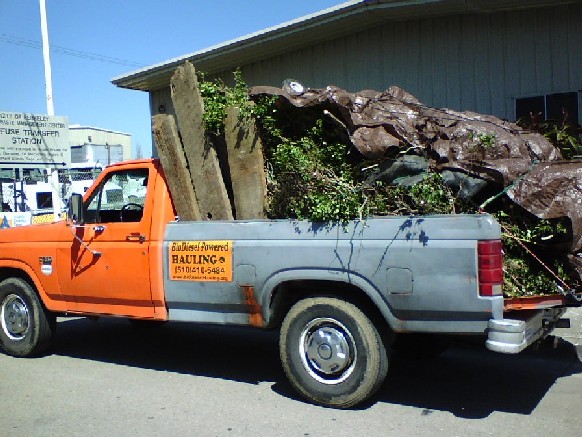
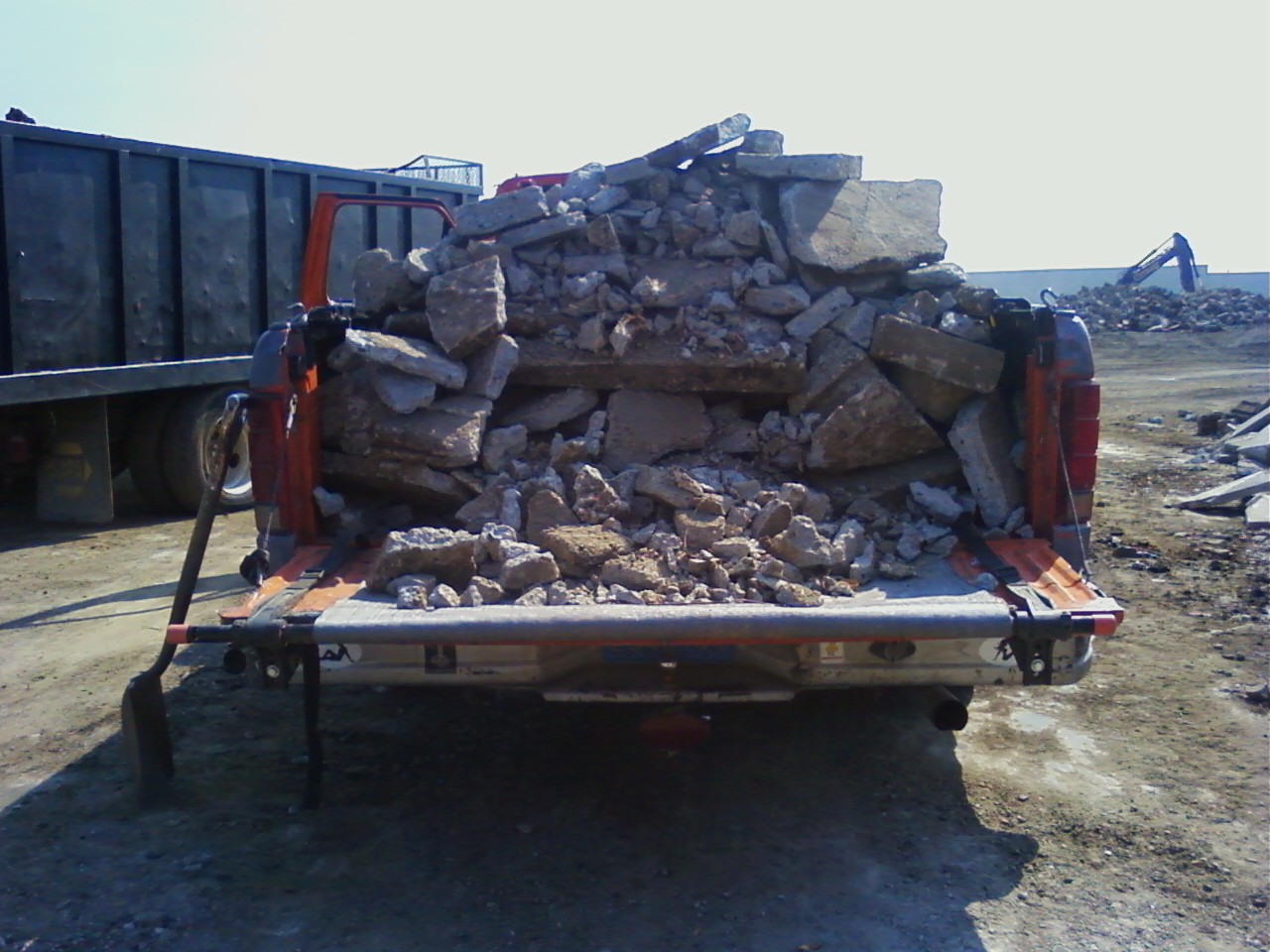
and hauling over a ton of concrete blocks, scrap wood, and plant debris on the freeway to the transfer station


As of my last fill up, my average mileage is 23.75mpg

Higher than the national average for all passenger cars on the road.
Higher than the average for model-year-2008 light trucks.

Next stop, eclipsing the average for all new passenger vehicles.

Wednesday, 1 April 2009

From one dishonest company to another


  • Apr 1, 2009

From one dishonest company to another


WTH? I just received the 3rd notice in 2 years of a class action lawsuit against a former employer.

Was I for some reason bouncing from one dishonest company to another?


I realize I have had a lot, and so statistically that ups the chances a little, and also that this is a very litigation happy place (owing to our severe lack of meaningful regulations and enforcement). And it shouldn't be all that surprising, given that the ultimate goal of any corporation is, by law, maximization of profit, which means that even following the law becomes a matter of calculating potential loss vs. potential gain: 10 years of unpaid overtime may be worth a 4 or 5 million dollar lawsuit.

I'm just hope I never receive one of those notices for my most recent job.  If all the employees of BioDiesel Hauling file suit against the owner, I have some serious problems, and not just the financial ones.

Saturday, 21 March 2009

My other project (trying to make my big commercial truck as fuel efficient as a car)

  • Mar 21, 2009

My other project (trying to make my big commercial truck as fuel efficient as a car)

After being pulled over for driving too slow, I looked up a couple hypermileing websites in order to post the story among people who might find it entertaining, and possibly offer some advice as to how to avoid/deal with the situation should it happen again. While there I found all sorts of ideas and suggestions I hadn't thought of and decided to attempt to make the truck itself more efficient to compliment my new driving style. This number is totally arbitrary and baseless, but my "goal" is 25mpg.
The average fuel economy of all US passenger cars on the road (not trucks, SUVs, or vans) is only 22.
The overall mileage for all US passenger vehicles on the road is only 17 - less than I am getting currently.
(And that's "passenger" vehicles. Technically my 5500lb diesel is classified as a commercial vehicle, even if I didn't use it for work)

Of course this whole exercise is more just for the principal than it is to save money, considering how much I spent on the project so far.

Completed so far:


-I built some homemade wheel "skirts" (wheel-well covers) to improve aerodynamics. The current ones, intended just as a test (though I may keep them as is if they work well enough and hold up) is made of cardboard (the box my new computer came in), coated in layers of aluminum tape, and then painted and edged with velcro. I lined the wheel well with velcro, and stuck 'em together, then taped over the seams with clear tape to cover the gaps of a less than perfect measuring and cutting job.


-I taped over about half of the grill (the engine runs too cold as it is) and the front turn signals to improve the aerodynamics of the front which stock basically looks like a multifaceted scoop designed to catch as much air as possible.[tape has since been replaced with coroplast sheet]


-The headlights come in a little scoop too, but since it's vital that the light not be interfered with, instead of tape I had covers custom cut out of thin Lexan plastic, which is totally clear, scratch resistant, flexible, and nearly indestructible (the same stuff my custom motorcycle windshield is made from). I traced the headlights and brought the tracing to Tap plastics who were able to cut them for me in about 5 minutes. I drilled holes in the corners and screwed them onto the grill so I can easily remove them if a headlight burns out.


-I ordered extra bright LED bulbs for the taillights and tun signals. They are brighter than stock but draw less power. The parking/brake/signal lights together use more power than the headlights, at 63 watts (parking) to 177 watts (brake) stock. The LEDs total 5.5 to 20 watts. This power is generated by the alternator, which is powered by the engine, so any reduction in electric draw ultimately reduces drain on the engine.


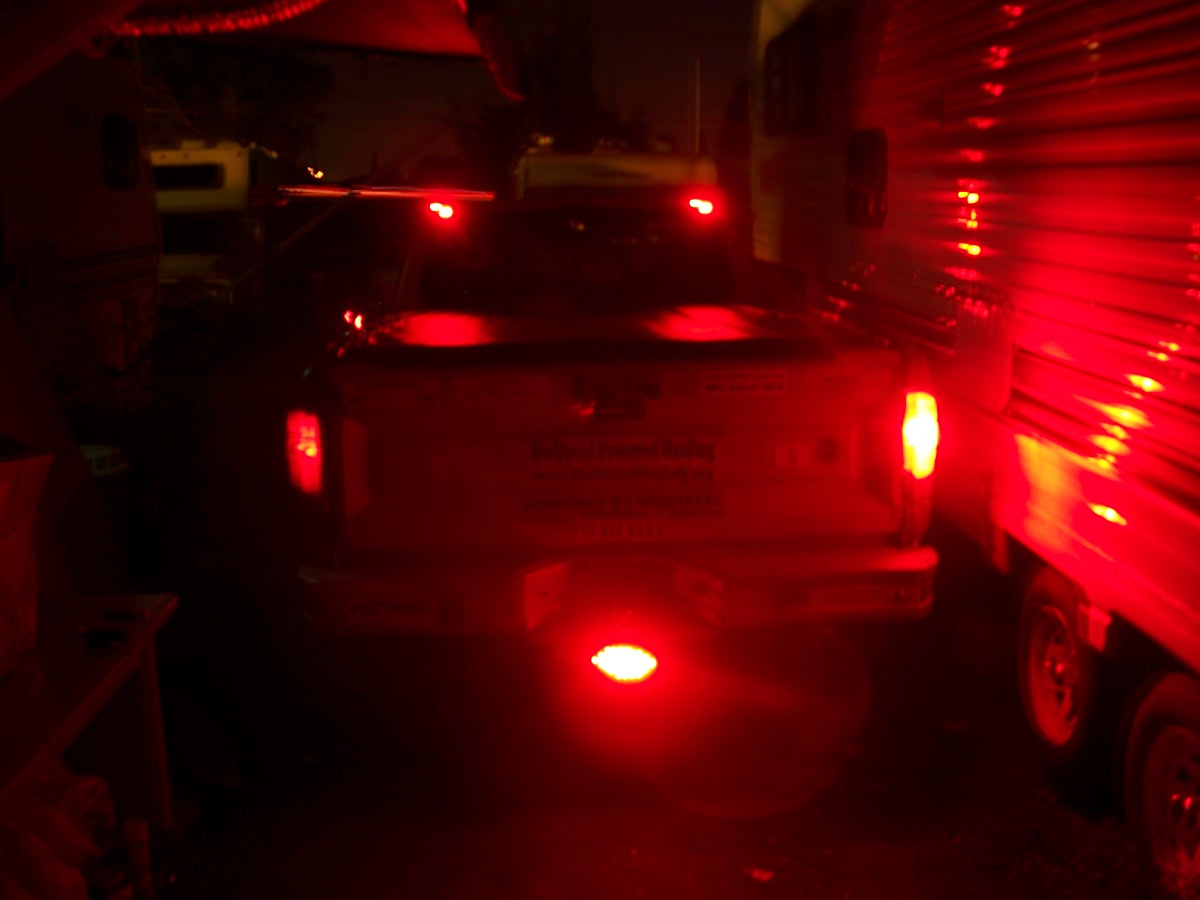
(while the incandescent - left - fills the lens more uniformly, the led - right - is so bright it lights up the surroundings and the edge of the tailgate)

(the difference is even more dramatic when the brakes/signals are applied)


-The dash lights alone used 15 watts. When I took apart the dash and instrument gauge, I discovered that the original system deliberately blocked and wasted the majority of light the bulbs put out by covering them with a slightly translucent cover, and then shielding the gauges on 3 sides. Which explained why the dash was always so dim. I broke off the filters, cut away the plastic shielding, and instead built reflectors (out of the same metal tape as my new rain gutters) to direct the tiny amount of light of my new bulbs on to the gauges. The result is far brighter than it was, and is all red which is easier on night vision (plus it looks really cool). I also added a voltmeter where there was an empty space before (where a tach would be on higher end models) so I can monitor the batteries if I decide to build in an alternator cut off switch


While I was working in the dash, I accidentally snapped the end of off the speedometer needle. It was extremely brittle, and as I tried to repair it, I ended up breaking off the rest. I replaced it using a match stick broken in half with a sewing needle stuck in the end, glued and taped to the post where the old needle went. I choose a needle with an orange ball on the end to match the truck. I drove past a couple "your speed is" automatic radar signs to roughly calibrate it.


I had been thinking about making a buzzer to remind me if I left the lights on, but then it occurred to me that there is really no situation where I need the lights on and don't have the keys, so while I had the dash apart I also rewired the headlights (and aux driving lights which I also just installed) so that they go off when the key is turned off so that I can't possibly accidentally leave them on and drain the battery (which would be pretty bad if I'm running sans alternator).

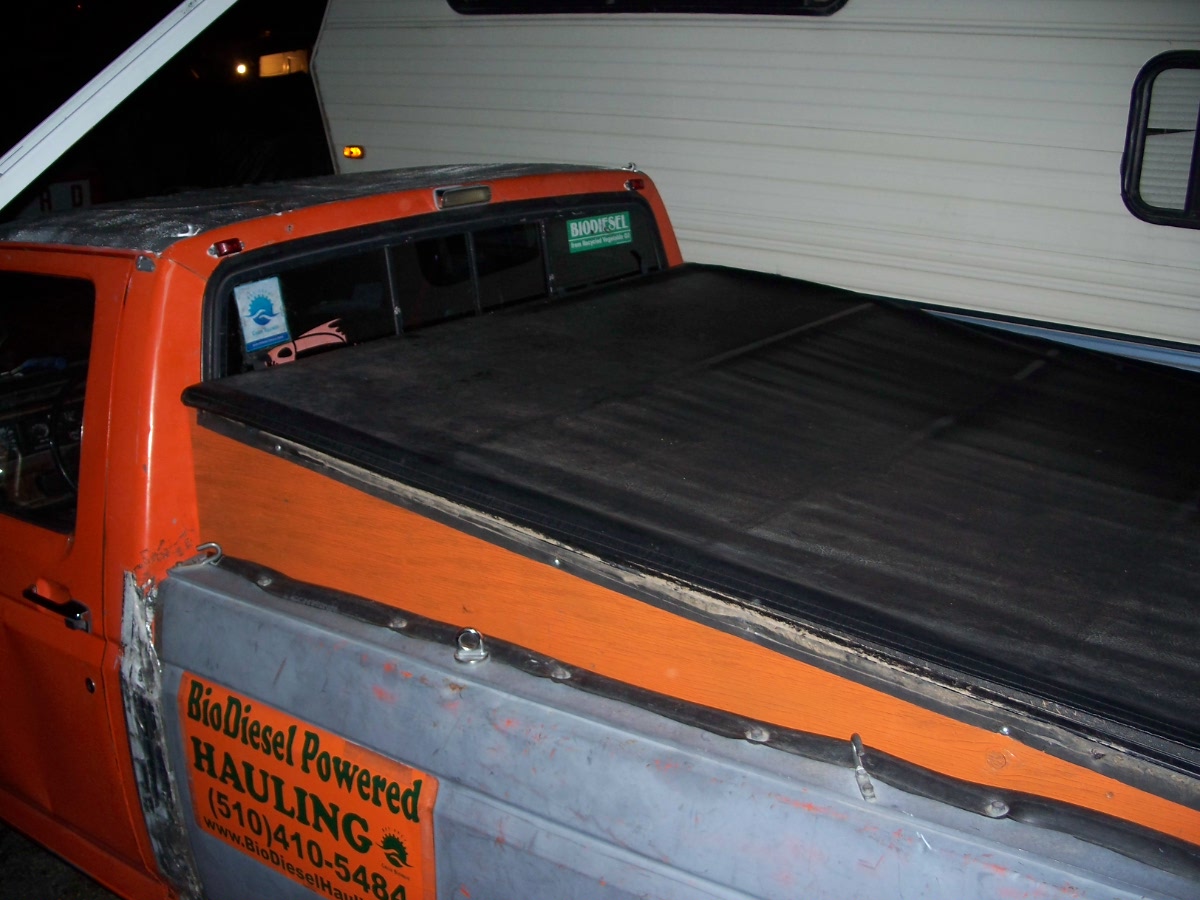
-I installed a tonneau cover which, in addition to increasing the trucks aerodynamics, will keep small loads clean, dry, and protected, making it a (semi)legitimate business expense. [this was later put on wood triangle rails, to tilt it to be even more aerodynamic]


-I also ordered an air compressor - the one I had wasn't nearly powerful enough for my trucks large high pressure tires. The portable Viair which runs off the truck battery, actually fills my tires faster than any gas station or mechanic compressor I've encountered. In addition to the valve caps with built in gauges I installed, this should help me keep my chronically underinflated tires up to standard.


(the valve cap turns red when tire pressure drops)

-Perhaps most important of all, I ordered a couple bumper stickers to explain to people behind me why I am driving so slow. Hopefully this should encourage people to pass, possibly inspire a few people to slow down themselves, and maybe even decrease the likelihood of future breathalyzer tests.


Future ideas include:

-Wiring in a engine kill switch and push button start. While this won't make a direct difference, it would allow me to start and stop the engine faster and easier (they would be mounted to the shift lever) without wearing out my ignition switch which will make coasting downhill and killing it at stoplights much more convenient.
[did it!]

-Replacing the power steering system with a manual steering gear. My steering box is worn out and needs replacing anyway, so this may actually save money upfront (it should be cheaper) as well as reducing the drain on the engine by allowing me to remove the power steering pump altogether.
[did it!!]

-Wiring in a switch to prevent the alternator from charging. I would then charge the large dual batteries at home each day. As long as I stayed with in the reserve capacity of the large dual batteries, I could run all electric systems off of grid power instead of fuel, but if I ran low I could always turn the alternator on (the power drain of the alternator can be as high as 1 to 2 horsepower)
[did it!!!]

-Replacing the stock hydraulic-clutch engine driven cooling fan with an electric fan which shuts off completely when its not needed (which is most of the time) moving one more engine draw to grid power (it would kind of make the truck a plug-in hybrid of sorts)
[did it!!!!]

-Replacing the 3speed transmission with one with overdrive. They were used in later years of the same truck, and so used ones that fit perfectly are available, and from what I read, I think I could do the labor myself. With the current high gear, optimal speed is only about 35mph, and considering the experience I wrote about recently...
[did it!!!!!]

I have wanted a 5speed ever since I got this truck, but even used they go for $400 or more. It would take a lot of tanks of fuel to justify that.

On the other hand, by my calculations based on made up numbers (ie, assuming I can get 25mpg out it), I should get around 190 miles more out of each tank compared to before I first heard of hypermiling.
The 500 miles I'd get out each tank would require $75 worth of biodiesel, (currently a little under $4/gallon) instead of the $125 at the old 15mpg or $100 at my current 20mpg. 500 miles is (very roughly) how far I go in a month, saving me $50 a month.
So, now that I actually work out the calculations here, for this blog entry, it seems I may hypothetically make back what i spent in a fairly reasonable amount of time afterall. If I keep this job long enough (and I have no plans to stop in the foreseeable future) that 5speed just might be worth it too.
[wrote about the install process here: http://biodieselhauling.blogspot.com/2012/07/adding-overdrive-bw-t-19-to-zf-5.html ]


Tuesday, 16 September 2008

MyFarm


  • Sep 16, 2008

MyFarm

Disclosure:
MyFarm is one of my clients, and I potentially benefit from them signing up new customers


------------------------------------------------------------------------

You have no doubt heard of the increasingly common services where a company regularly delivers a box full of fresh, usually organic, produce from CA farms, right to your doorstep.

MyFarm takes this concept a step further.
They don't buy from farmers, nor do they have land of their own.

When they say "local", they really mean it!

The space they use to grow organic vegetables in is literally right in your own back yard.

(And not the way people have been using the word "literally" to imply exclamation; I mean "literally" literally.)

They come in, assess the soil, assess the site (shade/sun, etc), discuss with you what you like to eat, and figure out what can be grown in your yard.
They build a garden, from scratch if need be (including bringing in organic soil if the existing soil is contaminated), install drip irrigation (the lowest water use type), and come back regularly to maintain it.

The customer can help with this process as much or as little as they like.

Essentially you are hiring landscapers - plus you end up with fresh, delicious, organic fruits and vegetables, from the most local source possible.

If you have a big enough yard, they may harvest more than you can eat, in which case some gets distributed to other clients in the neighborhood, and you get charged less.
You also may get some things from elsewhere in your neighborhood to allow for greater variety.

http://myfarmsf.com/

This is one of the most brilliant ideas I have heard in a long time (since NetFlix - oh if only I had had investment money back when I first heard about that idea - back when their advertising consisted solely of spam emails)

They contacted me about moving soil.
By sheer coincidence, the very next day I saw a segment on them on the show "Your Green Life".
I am looking forward to working with them.

I am making business contacts!
Every day this thing which I originally intended to be a way to make a little cash in between real jobs almost 2 years ago, becomes more and more like an actual business.
Its going to take a long time to get used to this.

Friday, 22 August 2008

my new life: accidental "green" rep and writer (or: excuse to post more links of my movies)


  • Aug 22, 2008

my new life: accidental "green" rep and writer (or: excuse to post more links of my movies)

I never set out, intended, nor expected to become a representative of the environmental movement, an activist, or really anyone special at all.

As I mentioned in blogs past, I believe the most significant and positive thing we can do to be responsible citizens is to truly live each of our own individual lives as close to our own principals as we can.  I believe this makes more real difference than all of the shouting, the signs, the email letters to representatives.  If everyone just did their own little part, there would cease to even be a need for the grand gestures.

And yet, as it turns out, apparently living by my modest principals has propelled me into this role without my having to try.

In just the past couple weeks:


I have been offered the position of vice-president of the board of a (not yet in existence) children's library, http://www.collectionlibrary.org/ (I am the only member of the board with neither an advanced degree nor related education and/or non-profit experience)

I was interview for a grad student's thesis (ok, granted, those first two are somewhat related)

I was filmed by faircompanies.com and have 3 short video interviews which touch on my home, my vehicles, and my business
http://www.faircompanies.com/main.aspx?uc=multidet&tipus=flv&id=258
http://www.faircompanies.com/main.aspx?uc=multidet&tipus=flv&id=260
http://www.faircompanies.com/main.aspx?uc=multidet&tipus=flv&id=259

I presented the awards (and gifts) to the team in Alameda county which logged the most commute miles during bike-to-work month last May (when I also volunteered, packing gift bags as well as at one of the energizer stations) at the Dublin city council meeting (the winner's were all employees of the City of Dublin)

I had the domain I originally wanted for my website http://www.biodieselhauling.com/ donated to me by the previous owner - despite my specifically requesting to pay for it, on the grounds of his liking what I am doing with it

Soon I will be running yet another free bicycle parking station at a local event http://www.artandsouloakland.com/ yet another thing which I am not quite sure how I ended up doing.

And with any luck, I'll end up a member of the Oakland Bike Patrol http://www.btceb.org/bikepatrol.php which is mostly an excuse to get me to ride my mountain bike more, but is also because, believe it or not, I kind of miss my old job as a private security guard sometimes - I actually got to help a lot of people.

You know what I always say: "Volunteering is for suckers.  Did you know so called volunteers don't even get paid?" (Homer Simpson)

Guess I'm a sucker.  But you know, its more than a little fun.
And I guess it just goes to show, it's really true what I thought all along - you can make an impact, just by doing what you do (as long as you're doing the right thing)

I still feel no need to be famous.  But I got to say, there is a certain narcissistic joy in having those videos out, and, honestly, would I be posting this if I weren't reveling in it all right now?

That's ok.  I could use a break from depression, insomnia, and preoccupation with things past.  Thus begins the next chapter of my life:

Bakari Kafele, The Bio-Diesel Hauler
Bakari Kafele of the East Bay Bicycle Coalition
Bakari Kafele, Collection board member
Bakari Kafele, Writer.

You know, I never thought of myself as a writer.
I guess it is my creative outlet.  I never thought of myself as creative.  I am not an artist, not by a long shot.  I am much better at repairing things than building new from scratch.  But the words in my mind, the letters are a canvass of sorts.
Looking back, I guess I have been writing all along.  I guess if you write, that makes you a writer.  My 4th grade teacher tells me he and my classmates all looked forward to my journal entries, which I read aloud to the class, when I was 9.
My first ever sentence ("The cow says moo") written in kindergarten was held up as an example before the school board of the sort of work the school was producing. (There was an accompanying picture of said cow.  I mentioned not being an artist.  Lets just say, if I tried to draw a cow today, it would not look much different from the one I drew at 5)
I used to write a lot of fiction, I still have a box of elementary school stories in the attic of the shed at my mother's place.  Somewhere along the line I lost the ability to write decent fiction (I have tried since, believe me, feel grateful I stopped), but writing has been central to expunging the ideas in my mind all along; from heartfelt, deep and personal letters to friends in high school to an unfortunate obsession with posting to the Craigslist rant and rave section for longer than I care to admit (which was only fully cured by starting my own blog)

But as it turns out, people actually read my narratives and essays. Why, in fact you are reading this right now!  During a recent severe depression induced bout of extreme insomnia, I found it imperative that I write down the thoughts in my head, just to keep them from consuming me.  Within a few days I was given a detailed break down of the artistic merits and shortcomings of my "poetry".  Just a couple days ago a former co-worker and friend I haven't spoken to much in years commented on something I wrote many months ago - he said that something I wrote was something he had never thought about before, and he said it was an excellent point.
That is the best compliment I can get.
It makes every hour on the keyboard worth it.

Such a digression this has become!  It was about being falling into the role of "green" representative.  Now it is suddenly about writing?  This is what happens when I don't give myself a couple days to think and plan out my blogs, but just start typing instead.

The other thing that happens is I have no idea about how to make a good ending

Wednesday, 20 August 2008

Take that capitalism


  • Aug 20, 2008

Take that capitalism

I finally got the person who had reserved "biodieselhauling.com" to release it from it's parked status.

It should be a few hours to process, but soon www.biodieselhauling.com will redirect to my website, www.biodieselhauling.org
Most people assume all websites to be .com, so this means a lot of confused customers will be able to find me a lot easier.

The person who owned it until today, a college student in Oregon,  he had a similar business idea to mine, and a few months before I first set up my website he reserved the name. 
I contacted him and offered to buy it almost two years ago, but he said he intended to use it in the next few weeks.
However, he never ended up using the site.  I checked in recently, and found it was still idle.
I contacted him again, and offered to buy it and let him pick a price.  He refused payment, and transferred the domain to me the next day.  I wrote again, explaining that I am using the site for commercial reasons, and offered to pay, at the very least, whatever he paid for the domain in the first place.  Again, he declined.  
Without a Paypal address or mailing address (the DNS had the school's address), there isn't much I can do.

He said he agrees with what I'm doing, and to re-invest what ever I would have paid him.

The GoDaddy website (who the domain is registered with) specifically encourages people to register domains for the sole reason of reselling them at a profit to someone who will actually use them. Plenty of people do just that, essentially web domain speculating - and making money while providing literally nothing of value to society.
This person did just the opposite - paid for a site, and then gave it away.

Take that capitalism!!

I am not the only anti-capitalist still out there.
There is morality, generosity, left in this country.
To the guy in question (perhaps he doesn't want his name public, but he knows who he is) you have all of my respect and gratitude.

Friday, 14 December 2007

3 letters to Utne


  • Dec 14, 2007

3 letters to Utne

I got a free copy of the Utne Reader at the SF Green festival.
First one I had ever read, although I recognized the name as something Aileen had recommended years ago.

It was chock full of interesting articles on a wide variety of important issues, many of which are relevant to me.  I think I'll subscribe.

Three articles inspired letters to the editor, (two of which are available to read on their website).


-------------

Salvage Beauty

I realize that the San Francisco Bay Area in CA is not necessarily representative of the rest of the country, but around here at least, this is not exactly news.

Our version of the "Loading Dock" - Urban Ore - in Berkeley, has been open for 25 years.
It opened originally with materials actually extracted from a landfill, and continues today with drop offs from haulers and donations from the public, as well as a recovery team at the nearby transfer station.
They are very profitable, employ a full time staff, and pay haulers and the public for high quality good condition items.
They have by now spawned a number of smaller copycat stores in the area, with somewhat more specialized focuses.

As a hauler myself, I face plenty of competition in this area from other haulers who, like myself, run their trucks on vegetable oil and donate / recycle / reuse and sell as much of what we pick up as possible.

Far from just making an incredible difference environmentally (both preventing landfill and reducing the need for new materials being made), it also makes great financial sense for everyone involved.
People shopping at a reuse store pay a fraction of what they would, many times for materials which are in excellent condition - sometimes never even used!
As a hauler, I pay much less in dump fees than I would if I simply disposed of everything in one place.
And that means that I in turn can afford to charge my customers a lot less.
Everyone wins.
I hope before long every city can take this concept as much for granted as we are able to here.
Until then, keep up the good work, reporting on stuff like this.

---------

Low Rent High Tech

One form of affordable and green housing which everyone always over looks is the RV park.

RVs as transportation are woefully inefficient, but keep one in one place...

RVs are designed to be able to run off of their own battery power and propane tanks off the grid for weeks or even months at a time.
Things like absorption cycle fridges and a tankless toilet (which have high premiums in home versions) come standard.

An RV uses less than 1/25th the electricity of the average American home, and around and 1/15th the average water.

At the same time, it is by far the least expensive (non-subsidized) form of housing. Both in the San Francisco Bay Area and 10 miles out of Manhattan (two of the most expensive areas in the country, where 1 bdrm apts can go for over $1500 a month) an RV space (with full hook-ups for water, electricity, phone, internet, cable, sewer, plus garbage and mail service) can be had for just over $400.

----------

America Incarcerated

I was very happy with my first ever issue of Utne, especially the unusually straight-forward and un-biased article on the issues surrounding the US prison system.  Expect a subscription after I finish this letter.

There were, however, a couple of points I wanted to add.
While it was, briefly, touched upon that everyone, regardless of circumstances, has personal choice and responsibility, it disturbed me how strong the implication was that certain circumstances "make" people commit crimes.  I am a black male, I grew up in a single parent home, on welfare and section 8 (subsidized housing), in a bad neighborhood where the sound of gun shots and police helicopters were only remarkable if they were actually on the same block as us. Not only have I not committed any violent crimes, I was never in any fights growing up, never been arrested, didn't drop out of school, etc. etc...
I don't think that anyone gets to use there living conditions as an excuse for their choices.  There is always something else a person could do to, say, make money to feed their children.

That being said, my larger issue is actually that the article did not go far enough in explaining society and history's role in creating the undeniable statistical trends which clearly parallel race lines.
While it was before any of our lifetimes, and we tend not to think of as real anything we can not personally remember, the truth is this is a very young country, and nothing in its time can be written off as ancient history. Slavery was incredibly recent: the civil war ended only 142 years ago.  (Contrast that to the time civilization has existed, around 5000 years).  That is in fact only about 2 lifetimes, or about 5 generations.
Meanwhile European Americans have had over 250 years to accumulate and pass down wealth.

In this country more than almost any other since the time of monarchies wealth is generated from already having wealth (which is literally the definition of capitalism), and inheritance is virtually unrestricted.

Most white families, (whether here from the beginning of the country, or immigrating here since then) started out with some amount of wealth (or had connections to someone here who did).  Freed slaves had literally nothing.  The reparations approved by congress never happened.  On top of that, Jim Crow and other discriminatory laws kept Blacks from accumulating any appreciable amount of wealth all the way up until the 1960s, a mere 47 years ago, less than a single lifetime.

That means that while white American families have been accumulating and passing down wealth for 10 generations, black American families are just getting started for the first time ever.

On top of that, our educational system is set up so that the primary source of funding is property and other local taxes, generally at the county level.  This means that wealthier areas are able to provide their kids with more and better equipment, computers, newer textbooks, and attract better teachers.  School which do poorly (largely due to under funding) are faced with having what federal funding is available cut - in other words, our system of penalizing under-performing schools means that the more a school needs money, the less it gets, while schools that are doing well (and therefore don't really need a bonus of federal money) gets more.

Between these two things, unrestricted inheritance and locally funded schools, is it any wonder how few people (of any color) break through the social class of their parents?  In this country we love to point out those rare success stories, such as Will Smith portraying the true story of a homeless stockbroker in The Pursuit of Happiness, but the reality is we have set up a social system that makes upward mobility all but completely unrealistic except in the rarest of cases.

The solution is actually pretty simple.  Although unfortunately I can't imagine anyone of influence daring to suggest either part any time soon given our current political climate.  One would be to essentially eliminate inheritance.  No one should be entitled to get money our resources they didn't earn.  Inheritance sets up a virtual caste system, where the luck of whom you are born to determines your chances in life.  It would be unrealistic to try to restrict it altogether, but a steeply progressive tax ranging from (say) 40% up to 75% seems to me reasonably appropriate and fair - for that matter, the same might be applied to all unearned income, which would also allow the tax rate on people who actually work and are productive to be reduced.
The second would be to make all public schools, K-12 as well as 2 years of college funded 100% on the federal level, with the same per-capita amount going to every school regardless of demographic, test scores, state, or whether it is rural or urban.

I also think that, as the author suggested, the use of drugs should be decriminalized (although the sale of many may be appropriate to remain illegal, use itself should be considered a disease) and given the current demographics this alone would go a long way to reducing the incarceration cycle in African American communities.  This may be more a symptom than a cause though. There are a myriad of other issues that relate to the social dynamics of race in this country as well.
However, I think if we were to change just those to things, a more reasonable distribution of un-earned wealth and an equal educational system, we would see major changes with in a generation or two with out having to do much further micro-management.

Friday, 26 October 2007

From my blog at faircompanies.com "what we are up against"


  • Oct 26, 2007

From my blog at faircompanies.com "what we are up against"

My neighbor came by a couple days ago.
(Neither the conservative in a tiny trailer nor the tweaker / junkies, I've never written about this one before)

I have new professionally made signs on the truck now, so its obvious I am running on bio-diesel (I think we had spoken about it once before a year ago or so).

He had read an article in National Geographic.

He came over to tell me that Bio-Diesel cost more than petroleum diesel.
Of course, I was already aware of this.

He asked why I used it.

I explained how being domestically produced and renewable meant we as a country were less reliant on imports, particularly from unstable places like the Middle East.
He was surprised that I thought we got a significant amount of oil from the Middle East. He thought it comes mostly from Mexico and South America.
I acknowledged that we do get a lot from those places, but it is not as much as we use, and we import huge amounts from across the ocean as well.
I asked why he thought we were in Iraq. He may actually have not heard me, because he is hard of hearing. Who knows?

So I went on to explain the significant difference in emissions, both in terms of greenhouse gases and regular air pollutants.

He was amazed that I actually cared about that, or felt it was a personal issue.

I pointed out that I have to breathe. He said "well we ALL have to breathe"
"That's exactly my point"

When I mentioned that we pay much less for gas than most places, he said he didn't believe it. He went on to say that the article said in Italy they pay over $6 per gallon. Yet he was still sure that because of license fees and unspecified taxes, we still paid more per gallon in the end.

When I pointed out that gas prices will explode within the next decade as supply gets lower, he said he doesn't expect to be around that long (which is odd - he is retired and hard of hearing, but he still has brown hair, and is very active. He still rides his Harley. He isn't all that old. I think.)

I asked if he had kids. He said they were older than me. I asked if he was concerned at all about the air quality and economic climate for them. His response was not straight forward, but seemed to be a combination of 'it won't get too bad in their lifetimes either' and 'someone will solve those problems sooner or later'.

He kept going back to asking why I would spend more on fuel if I didn't have to. I said it was a matter of being a good citizen, like voting. I decided against asking if he voted.

He found it very interesting that I felt that things like international politics and the environment were relevant to me personally.
He insisted he had NEVER met anyone who thought that before. (Or at least no one who admitted it.)
I said I had a lot of customers who felt that way.
He said "maybe in San Francisco". "And Berkeley" "Well, yeah in Berkeley".
We live in Oakland. Oakland in right in between SF and Berkeley. He has lived here for at least a decade or two (I can't remember, it may have been longer) and has never met what you might call an environmentalist!?!?

This is a guy who occasionally flies an American flag over his home (more often its the Jolly Roger).
He babysits for another neighbor. He never rants about "liberals". We talk now again - we both have motorcycles, so sometimes about that. He tells stories of his life. Regular guy. He wasn't the slightest antagonistic about my views. He was just surprised.

He could see how if that stuff mattered to me it might be worth it to buy bio-diesel. For him, he said, all that mattered it the dollar cost.

We tend to focus on the exploitative corporations, corrupt government, fundamentalist religious people, and hummer drivers.
I think our biggest obstacle is all the ordinary people in between. We shouldn't be an "extreme", but unfortunately, in this country, we are.