Showing posts with label efficiency. Show all posts

Saturday, 6 July 2013

If I Were Elected King of the Country

My new friend asked me a few weeks ago, "what would you change about the world, if you had the power to?"
She said she tried to ask all new people she met that question.
She said it was surprising how many people didn't have an answer because they had never thought about it.
I couldn't answer, but for a very different reason.
I just couldn't sum up, couldn't choose from the list what to say first.
I've been thinking about it ever since then, and I still can't find any way to tie all the various things together, so, instead of going into the detail about how and why for each one, I think I'll just list as many as I can think of.
(and if anyone wants elaboration on any in particular, ask me as a comment, and maybe I'll make that one its own post)

These are in no particular order:

----------------------------------------------------------------------------------------------------------------


Election day would be a national holiday.  No one could be forced to work more than a 4 hour day on election day. 

Anyone not registered to vote would pay a small annual penalty with their taxes.

Judges would be subject to recall by popular vote.

Congressional, presidential, and governor terms 6 years.

All term limits would be eliminated.

All elections would be instant run off type (or another equivalent to eliminate "lesser of two evils" votes).

Party, primary, and electoral college systems eliminated.

Voter initiative process on federal level, and all 50 states.

All campaign related ads would be banned from TV, radio, print, direct mail, and billboards, starting 1 year prior to any election.  Each candidate or initiative would receive expanded space in the official election guide.  All statements made that could not be verified by an independent 3rd party fact checker would be marked with an asterisk.
No individual could donate more than $500 to any campaign or political organization in a year.  No company or corporation could donate any amount to any campaign or political organization.  No union, church, or other group could donate without 100% unanimous consent of all members, and then no more than the equivalent of $100 per member.  For any amount an individual spent out of pocket for a campaign, they would have to contribute an equal amount to the public campaign fund. 
All of this would be less important, giving the ban on media ads.


Media (of any form) which reports any mistaken information or error as factual, would be required to report the correction with equal or greater prominence and length of time as the original mistake (if error was headline for 3 days, retraction must be headline for 3 days)


Public school would be paid at the national level, by number of students (regardless of performance).  Any outside income (gifts of cash or supplies by parents for example) would reduce funding by 50% of the amount of income (i.e. parent donates $100, then federal funding is reduced by $50), used for the pool, to benefit schools with less generous parents.

Teacher training and classroom curricula would be evidence based
No multiple choice test could be used for assessment.  Guiding principal should be teaching for understanding, not just retention of facts.

Preschool and kindergarten would both become mandatory and free.
2 and 4 year college / university would be voluntary, free for any family below median national income.
All college finals would be administered one semester after the end of the class (to test for long-term retention)
Public school teacher salaries would be cut by roughly 5-10% (approximately the amount private school teachers make), principals and administrators by 25-50% (to be within 25% more than teachers).  All of this extra money would go to hiring more teachers to reduce classroom size. 

Teachers would have at least 15min of prep time for each 55min of instruction.
They would be eligible for overtime after 112 hours per month(equivalent annual hours to other jobs, considering summer and other breaks - after reduced work hours, (see below))
Cognitive biases, logical fallacies, and predictable irrationality would be a required course in middle school, high school, and college (beginning, intermediate, and advanced, respectively).


Drug use would be decriminalized.  Selling without a license would not be.  Prostitution and gambling would also be legal, (though regulated and taxed).
No law or regulation could stay in effect unless it can be shown to tangibly benefit some individual or society as a whole.
No censorship of "indecency" (nudity, sex, language)
Sex ed would be taught in preschool, 5th grade, and 12th grade, each class more advanced and in-depth (the first would be similar to current Jr High level, the last would be equivalent to college Human Sexuality course).  It would be a graduation requirement, so no opt out.

It would be illegal to formally teach any child below the age of 18 any form of religion, (other than in a historical or sociological context).  This would include attending services.
Churches would no longer be tax exempt.
No government recognition of religion or God, even in a neutral, non-specific way (e.g. "...One Nation, Under God..." or "In God We Trust")


All pronouns would be replaced with gender neutral ones.
All restrooms and locker rooms would be unisex (with individual stalls, and/or separate areas of the room optionally)

Combat and infantry roles would be available to women in the military.

No government or business could mandate different dress codes by gender.
This would include that women could be topless anywhere that men could.
Public beaches and parks would be clothing optional.
All laws on sexual assault, age of consent, marriage, etc would be gender neutral (this would, among other things, inherently legalize gay marriage).

No cosmetic surgery (including circumcision and pierced ears) before the age of 18


All subsidies and price controls for feed crops would be eliminated.
Minimum standards for animal welfare would include daily access to outdoors and a diet resembling a "natural" one - i.e. herbivores could not be fed animal by-products, nothing would be fed manure, nor its own specie, nor a reciprocal specie (i.e. Animal A is fed animal B, and animal B is fed animal A)


All new cars would be governed to a maximum of 65mph, or to the maximum of the state is is sold in, whichever is lower.

Each lane on any highway with 2 or more lanes in each would direction would have specified lane speeds. A two lane would have a maximum speed of 65 and minimum of 55 in the left lane, and max of 55 and minimum of 40 in the right. 
For a 3 lane, from the left, the speeds to maintain would be 60mph, 50, and 40 (each +/- 5mph).  A 4 lane would be 60, 55, 50, and 45 (+/-5).  A 5 lane would be 60, 55, 50, 45, 40 (+/-5). 
Speeds on all highways would be monitored by randomly placed, (and periodically moved) radar machines - a combination of the radar systems that say "your speed is:" and the camera detection system that catch red light and toll violators.  Like the latter, they would look up registration by plate number, and mail you your ticket.
The first 2 violations would be warning.  The 3rd would be a $100 fine.  The 4th would be a $500 fine.  The 5th would be one week mandatory community service.  The 6th would be license suspension for a year.

No one could get a drivers license without an intensive driver's ed class (50 hours minimum).  It would cover all the basics, plus: changing oil, checking tire pressure / fluid levels, changing a wheel, and safety check - cone tests, parallel parking, driving in reverse - calculating speed, distance, and time, as well as braking distance and impact force at different speeds - fuel economy, basic hypermiling - safe and legal bicycle operation - auto crashes, causes and prevention - practical accident avoidance, using simulator - poor weather handling, rain, ice, snow, fog, and glare - driving with manual transmission.  The final test could not contain any multiple choice questions, and would cover all topics, some as hands on skills tests.
Driving class (as above) would have a 2-3 day mandatory refresher course every 10 years - every 5 years before age 25 and after age 60, as well as after every moving violation or accident
No communication device while driving (including hands free) except 2-way radios used in the course of a job which involves driving (truck and taxi drivers, emergency services)
Public safety tax based on weight for all motor vehicles, added to annual registration (i.e. one pays for the additional risk to everyone else caused by their choice to buy a 3 ton SUV rather than a 1 ton car) - based on the grand total public cost of all accidents, divided by the total number of registered cars, proportioned by weight.
Anyone found to be 1% or greater at fault in any auto "accident" would be automatically charged with criminal negligence.
Revoke mandatory airbags, seatbelts, crash rating standards.
Traffic lights would flash green before turning yellow (as in Mexico).  They would flash red before turning green (so you know to turn your engine back on)
Stop signs would be considered yield signs for bicyclists (as in Ohio)
All 4-way stop sign intersections would be converted to either a 2-way stop, a traffic circle, or a stop light.
All major one-way streets would have timed / synchronized stop lights.
50% tax on retail gasoline, money used to subsidize public transit.
At rush hour, instead of a carpool lane, the left most lane would be for commercial vehicles (being used for work, not for commuting), transit, emergency services, and people with permanent disabilities only.  On highways with 3 or more lanes, the next one over from the commercial / handicapped lane would be for carpools of 4+ people, plus toll road paid by electronic RFID tag


Upper limit of inheritance or gifts of $10,000.  The government income from estates would replace all (or at least most) of the income tax.

The rate for any remaining income tax would be at least half for earned income (wages / salary / commission) as for unearned income (dividends, capital gains, gifts, prizes).

The tax rate on unearned income would be steeply progressive, with a maximum rate of 99% after $100,000.

One may only own land which you personally live and/or work on - i.e. a maximum of two parcels (one for work, one for home) per person.  They can be any size, so long as they are a) continuous and b) actively and directly used by the owner in some way.

No one could have more than 2 households as tenants, and then only if the tenants share the same parcel that the landlord lives on.

Corporate charters would only be granted for very specific circumstances, where it is demonstrated that the product or service offered could not be provided by a privately held company, and that it is of overall benefit to society.  Any charter application which met those standards and was granted would be for a specific and limited time period - 1 year by default, 5 years with requested extension, 10 years considered with an explanation of the need for a longer time period.
Patents and copyright would be good for 10 years, or until a 25% return on investment was made by the patent/copyright holder, or until the applicant dies whichever came first.

Business licenses and fees would be by percentage of net income, not flat amounts.
Business insurance companies would be required to offer a broad range of coverage and deductible amounts, so that small scale and hobby businesses with low maximum potential risk could afford coverage.
Any form of business could be run out of one's residence unless a specific risk or harm to the neighbors could be demonstrated.  "Lowering property values" would not in-and-of itself be a valid form of harm.

Employers would not pay for the employees' payroll taxes.  The employee would cover the full amount of their own social security and medicare taxes.

Employers would also not cover medical insurance, but that would be irrelevant, because there would be nationalized, single payer, health care.

1/2 of company profit would be distributed equally among all employees, without regard for title or position.  Any increase in efficiency due to improved technology that were not passed on to the consumer would be distributed to employees either in the form of fixed hours and increased salary, or fixed salary and decreased hours.
No one could sue for loss of profit.
A company with more than zero profit could not lay off employees.

Overtime would be anything over 86 hours per month, would pay time and a half, no exceptions by profession, would apply to salary and commission as well.  Double time after 172 hours in one month.

No company or corporation could buy another.

No company could have more than one location, except in those cases where the nature of the company required multiple locations (such as delivery service).  Exception could be made on a case by case basis, if the expansion could be shown to benefit society as a whole enough to offset the anti-competitiveness.

Any company based in the US, or with a majority of US shareholders, or with 1% or more of product exported to the US, must follow all US wage, safety, and environmental laws and regulations, regardless of the location of production.  (For example, if a company builds a factory in China, they still must pay US minimum wage if they want to export the product into the US)

No US military protection of private property, on US soil or abroad.  For example, US oil companies would have to pay for their own private security to guard pipelines.  Private corporate interests could not be considered "national interests", even if the product they produce is of value to the nation.


Any action of military or CIA is automatically war, whether or not it is officially declared.

Any action longer than 5 days must be approved by congress.  Any action longer than 60 days must be unanimously approved by all 50 states (via senators and/or governors).  Any action longer than one year requires majority vote of all US citizens.
Military budget reduced by 90% (give or take).  It could never be increased to more than 10% less than whatever nation has the highest military budget.
Universal conscription of all citizens at 18, both genders, deferments for medical issues, but no other reason.  Everyone must attend bootcamp.  After that, choice of 2 years of either military service, or civil service.


In middle school, high school, and college, reversible long-term birth control would be provided at no cost to both genders (yes, the technology exists).  This would be voluntary, and either child or parent could choose to opt out for any reason, however it would be the default - everyone would get it unless they actively choose to opt out.
(Voluntary) permanent sterilization would be provided at no cost to all adults.

All forms of contraceptive would be covered in full through health care.

Child tax credits would be eliminated.

Welfare would provide a fixed amount per household - it would not increase with additional children.


Universal, single payer healthcare - however, in order to engage in certain high risk activities, you would have to opt out.  You would present your opt out card before buying cigarettes, and to get a registration sticker with a stripe which indicates you may drive a car without a seatbelt of ride a motorcycle without a helmet.  Possibly also for purchasing more than a certain quantity of alcohol at one time, and certain foods.  Anyone who opted out could be refused service at any hospital unless they pay in full in advance, even in emergencies.  They could still purchase private health insurance, if any private insurer wanted to cover them.


Citizenship would not be automatic:
At age 18, each person would need to pass the same citizenship exam that immigrants have to pass (this would be covered in high school). 
They would  have to go to military bootcamp, and then either serve in the military or in civil service for 2 years.  They would have to register to vote. 

Anyone choosing not to apply for citizenship would be considered a native resident. 

Native residents would not have to pay any taxes.

They also could not vote or run for office.  They would not be eligible for public assistance, including health care and (college level) education.  They could not drive motor vehicles on public roads, nor sue in court.  They would be responsible for the labor, fuel, and expenses if using emergency services such as police or firefighters. 

One could apply for citizenship at anytime, up to age 40, however, once revoked, you could not get it back for 15 years, and would have to begin the process from the beginning.

Saturday, 29 June 2013

Your Actions are (part of) Causing that Traffic Jam You're Stuck in*

*In the morning and evening of most large American cities (especially those surrounded by plenty of suburb), when everyone is driving their cars to their 9-5 jobs, there are simply too many vehicles on the highway for the lane capacity.  You get on the highway at the nearest entrance, and proceed to average 15mph the entire distance from your suburban home to the downtown city center where you work, frequently coming to a complete stop, never going more than 25mph at the most.

In that situation, traffic is going to go slow, no matter what.
That isn't the type of traffic jam I'm talking about.
There is also another type of traffic back up.  The kind that happens in moderate traffic.  Everyone slows down, sometimes even to a complete stop, and then a few hundred feet later, you are moving again at 50, 60, 70mph, as if nothing happened.
Sometimes this happens because there is the aftermath of a crash in the shoulder, or even across the divider on the opposite shoulder of the oncoming lane, and all the drivers feel it is very important for them to take a good look at it, because humans are just like that.  Other times its because someone is getting a traffic ticket, and, even though the cop is clearly busy at the moment, people imagine they are more likely to be caught speeding if the can see a police car.
But most often, these slow downs happen for no apparent reason at all.  You get to the front of it, and cars are accelerating just as suddenly as they slowed down.
Sometimes traffic pulses like this, fast - slow - fast - slow - fast - slow for miles.  In some places, not quite as dense as in the first example above, the daily commute does this pulse jam every single day.
When you find yourself in this situation, the choices you make can either make it better, or they can make it worse.  If you are reading this, there is a decent chance you are one of the few who makes it better already - but if you are like most people, there is a much better chance you are making it worse. 
In fact, if everyone realized what I'm about to explain, and acted appropriately, those slowdowns would never happen in the first place, but, of course, most people don't know any better, so its hard to hold it against them.
At least once you have finished reading this, there will be one more person who understands whats going on, and makes it better instead of worse.

The easiest way to understand how individual actions make the backup better or worse is with an analogy.

Lets say you are in a crowd, and for some reason everyone wants to go through a doorway as quickly as possible (the iconic burning theater, perhaps, or maybe just a Black Friday sale).
Each individual is acting as an independent free agent, and each wants their own personal speed to be as fast as possible.
What happens? 
Everyone rushes the door, and they get stuck on each other as they try to squeeze through all at once.  In extreme cases people get trampled, occasionally fatally, but even if everyone stays on their feet, the chaos amplifies the bottleneck and it takes an even longer time for everyone to get through.


Now consider an equally large crowd, but imagine they consist of a highly trained military company.  When the fire alarm goes off, instead of each individual going straight for the door and attempting to shove each other out of the way, they all immediately form a single file line down the center of the room, each taking their place based on where they started, no one "cuts in line", everyone moves at a quick but controlled pace and never any faster than the person in front of them.
In the second scenario the very last person to go through the door gets through faster than the middle person in the free-for-all scenario.
What has changed?  Each individual is moving a little bit slower, they all give each other a little more space, and no one runs around to the edge of the door to try to squeeze in from the side.  The exact things that people acting as individuals do to try to optimize their own individual escape time are what cause them to get stuck on each other and, paradoxically, means they and everyone else gets out slower.
Researchers have looked at this phenomenon of "more haste, less speed":

The desire for speed overwhelms the desire to avoid collision and the blob people jam up against one another -- just as salt can jam the shaker even though the hole is bigger than the largest grain. The room takes longer to empty even though everyone tries to move faster -- handfuls of people escape in bursts between clogging events.

You can see something analogous on the highways everyday.  Drivers attempt to go as fast as possible at all times, even when there are other cars ahead of them.   Many tend to drive as close as possible to the car ahead, much closer than the recommended 2-3 second rule from drivers-ed class.  When coming up on a line of stopped cars ahead, they will keep a foot on the accelerator as long as they possibly can before hitting the brakes hard just in time to prevent impact.  And any time one lane is temporarily going slightly faster than the one they are in, they pull into it to gain one or two car lengths over those around them. 
The overly aggressive drivers are obvious.
But almost everyone contributes, if to a lesser extent, to the same general phenomenon. 
Say every car is as close as is safe to the car ahead, in every lane, and everyone is moving at a constant rate.  Now what happens if one car wants to change lanes?  Since the cars are all as close as can be already, there is no possible way that the car can change lanes smoothly, because someone is going to have to slow to let them in, and they will have to slow to make the merge.  Now the following cars in both lanes have to brake.  And since the cars behind them were already as close as possible to them, those cars also have to brake.  And since the cars behind them... you get the idea... the stopped cars now travels back through the traffic in a wave. 
Now the same scenario - except the drivers are self-regulating like our military company escaping the burning theater: each car leaves a gap from the car ahead of them large enough that another car can safely merge in front of them.
Now when a car inevitably needs to change lanes, they can do so without slowing down, and without making the car behind them slow down.  They and the car behind them will want to reopen the gap that they just filled, but this can be done gradually over time, with only minor adjustments to speed, and the wave of stopped cars never occurs.

Traffic engineers can control individual driver behavior by putting in deliberate bottlenecks, called metering lights - the kind found at toll plazas and some on-ramps, where everyone is supposed to wait just a couple seconds before they merge with traffic.  Everyone ends up on the highway, but that moment of waiting forces everyone to space themselves out, and even though you had to wait, it is more than made up for by higher average speeds for everyone - including you. 
Sometimes you can even see a similar effect from lane closures or rubbernecking - a section of highway that is moderately backed-up everyday, but on one occasion has a lane closed for construction or due to an accident, if its near the beginning of your trip, occasionally has you get to your destination faster than usual.  As the cars slow down for the bottleneck, and then reach the end and start to accelerate one at a time, they spread themselves out, just like a metering light would have done. 
An identical effect is seen with the crowd of pedestrians trying to get through a doorway; putting an obstacle in the way of the exit actually makes the crowd get though it faster.


Most fire codes require that the pathway to an emergency exit be kept wide open, but according to researchers in Japan, placing an obstruction next to an exit may actually help crowds of people to get out of a room more efficiently.

Researchers found that when people bottleneck near an exit, they start to jostle each other for position. The jostling acts much like friction, slowing down the rate at which people can exit. Introducing a strategically-placed obstacle near the exit can reduce the number of people pushing for the exit, speeding up the rate at which people can pass through.

"We found that we can evacuate faster if we put an obstacle at the suitable position in front of the exit," said Daichi Yanagisawa, who lead the study from the University of Tokyo in Japan.
Even without metering lights, though, you can make a conscious choice to help traffic you are in move more smoothly.
Pay attention to the road ahead.  If you see an ocean of brake lights up ahead, take your foot off the accelerator.  There is no point in racing to be the first to come to a stop.  Resist the urge to change lanes every time one appears to be going slightly faster, unless you have enough space that you can do it without anyone having to slow down for you. Leave a big enough gap between you and the car ahead of you that someone else could safely merge in front of you without you having to slow down.  That applies at any speed, from stop and crawl to over the posted limit** - not only will it smooth out traffic flow, it will also reduce your chances of being involved in a collision, not to mention reduce other people's road rage.  No one can cut you off if you choose to slow down and let them in.
That means people will get it front of you.
And that's ok.
At as slow as 10mph, one car length costs you all of one second.  At 35 it costs you one third of one second.  Big freggin deal!  Let 50 cars get in front of you on a trip with a 45mph average speed, and you get where you are going all of 30 seconds later than you would have had you made sure to be the one to go first.
Not only have you made 50 people a little happier, but you have helped traffic flow a little better for all the people behind you, all the way back down the highway.
Better still, when you are coming up to one of those pointless braking waves, and you start slowing down well in advance, often times it will have completely cleared itself up by the time you get to where it was.  Which means by simply taking your foot off the accelerator, you never have to brake at all.  By avoiding coming to a complete stop, your average speed ends up being higher!  Its quite like timing traffic lights - if you try to go faster than the timed lights are designed for, you have to stop for the red, and someone driving at the speed limit will pass you just as it turns green again while you are accelerating from a stand still.
And if driving with less pointless starting and stopping, less stress, and helping to clear up traffic jams wasn't enough, this also happens to be the best way to minimize fuel when driving in traffic, so you save cash too, along with the environment and America's energy independence. 

Next time you are driving, think about this essay.  When someone exits in front of you, leaving a huge gap between you and the next car, don't rush to catch up.  When you are entering the highway, and the on-ramp is clear but the merging lane is slow, don't stay on the on-ramp until the very last second and then cross over the solid white line in an attempt to pass as many other cars as possible.  You are saving yourself a negligible amount of time, probably less than a second, but you are creating a braking wave that will snarl the traffic behind you potentially for miles.  Think about the orderly single file line, and how much faster everyone exits the building.  Everyone else is going to drive how they are going to drive, but at least you won't be making it worse.  And who knows, if enough of us start doing it, a few others might just take notice, and sooner or later stop and go traffic waves will simply cease to exist.

Wednesday, 24 October 2012

Aerocaps for pick-up trucks

Aerocaps for pick-up trucks

by Bakari Kafele on October 24, 2012
AerolidWhen people think about fuel economy, they usually think about small cars, perhaps a mid-size hybrid.  If they think about trucks, its usually to contrast them with a more efficient vehicle (and perhaps chastise truck owners for their wasteful choice).
But while cars are great if you need to get yourself and maybe a few other people from one place to another, they don’t excel in moving large amounts of stuff, and can’t tow very much.
If you regularly need to move lots of big, bulky, or heavy stuff, or tow something large and heavy, but rarely need to move more than a couple people, a truck makes a lot of sense.
Of course there is a reason that trucks are seen as inefficient: they are.  They are heavy, overpowered (although cars are even more so these days), and not at all aerodynamic.
Then again, because trucks get such low mileage to begin with, improvements in their mileage have a relatively bigger impact.  For example, an increase of 15mpg for a 45mpg car is a 33% increase and will save 55 gallons of fuel over 10,000 miles.  Not bad, but that same 15mpg improvement to a 15mpg truck is a 100% increase, saving 333 gallons over the same distance.
So what is a mpg-conscious person who needs to move a lot of stuff to do?


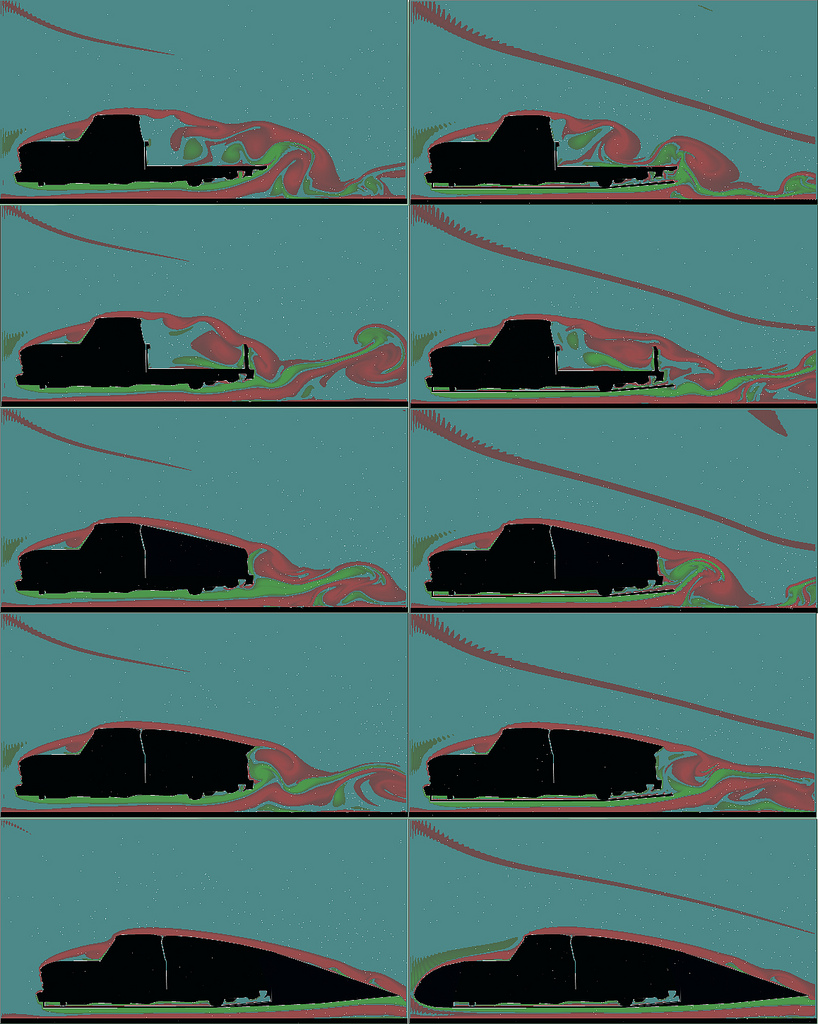
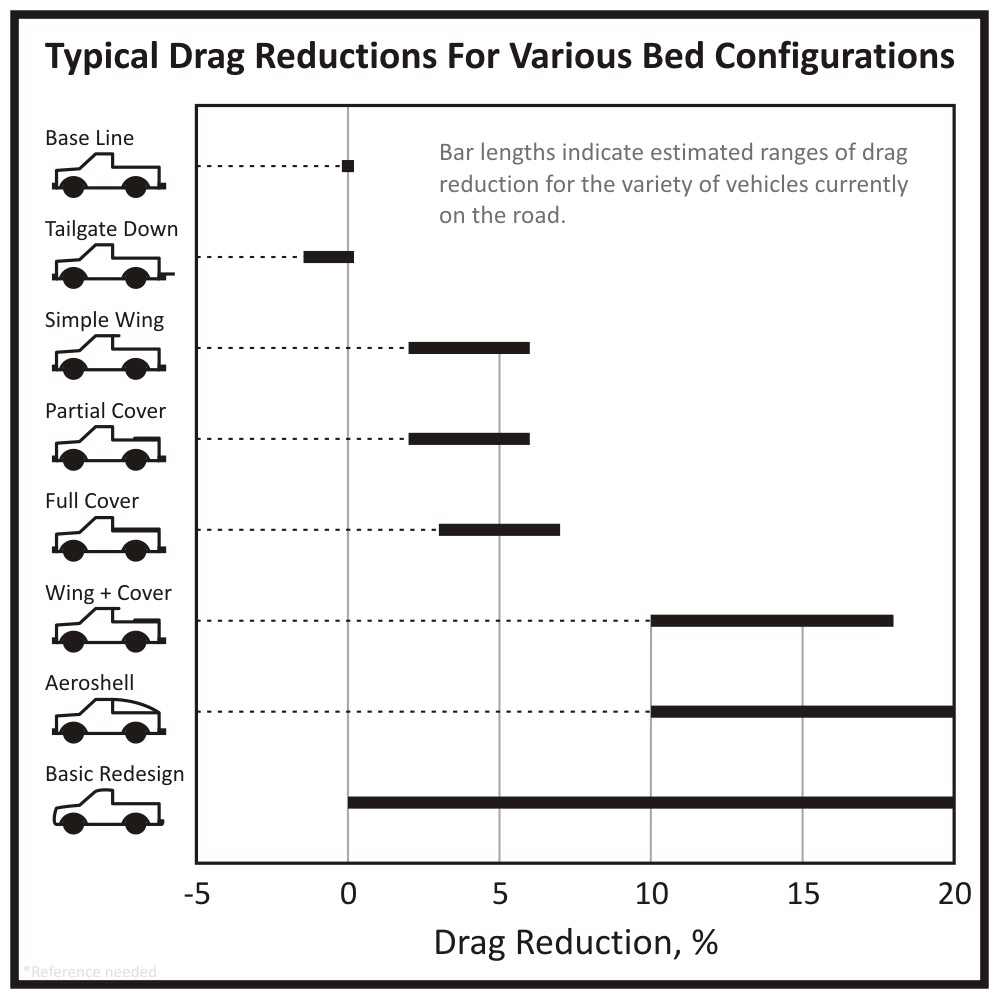
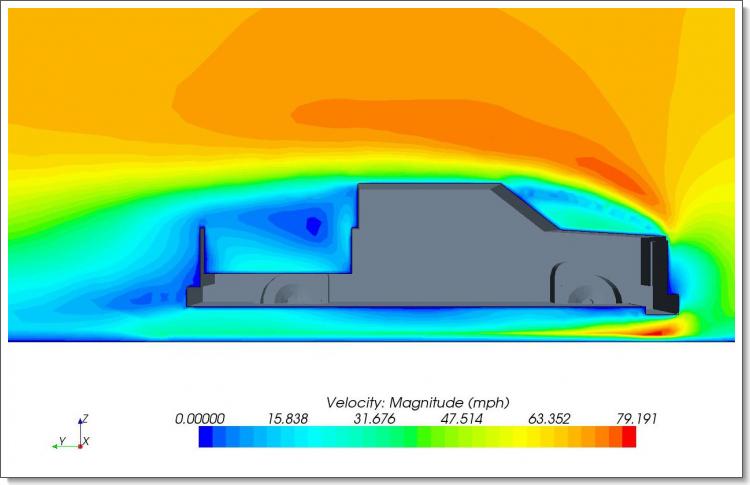
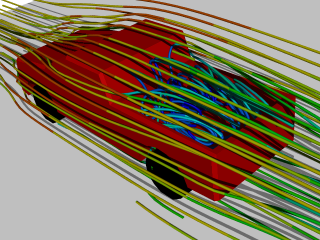
The classic question was whether its better to drive with the tailgate up or down – the reasoning being that the tailgate might be catching the air coming off the roof like a parachute, being a flat vertical surface and all.  It turns out though that (at least for most trucks) that at speeds an air bubble naturally forms in the truck bed of an open bed pick-up with the tailgate up, and that creates a virtual tonneau which deflects the air current over the gate.  With the tailgate open, that bubble can’t form, and aerodynamics is actually decreased overall, reducing MPGs along with it.


(image from: http://johnversteeg.com/projects/2 )

(image from: http://www.symscape.com/blog/tailgate-up-or-down )
It’s important to note that this does not seem to be universally true; while the MythBusters and some (better controlled) studies have found better fuel economy with the gate up, other studies have found the opposite: reduced air drag with the gate down.
Which actually shouldn’t be too surprising, given the complexity of fluid dynamics, and the plethora of shapes and sizes and other variables that go into the design of a truck bed, cab, and tailgate, from length of bed and height of cab, to whether edges are sharp or rounded.  In any case, neither shape of truck bed is optimal for aerodynamics, and the potential improvement gained by tailgate position is relatively minimal.
The next step in truck aero evolution is the tonneau.  When installed, it makes the truck bed a solid flat surface at the height of the bed rails and tailgate.


Now instead of a virtual surface closing the truck bed, consisting of a bubble of air, there is an actual surface there, to do the same thing.
Unfortunately, this is still far from the ideal tear-drop shape, and (again, unsurprisingly) while it is frequently seen to improve fuel mileage, it isn’t by terribly much, and it doesn’t consistently show any improvement at all.
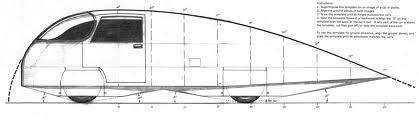
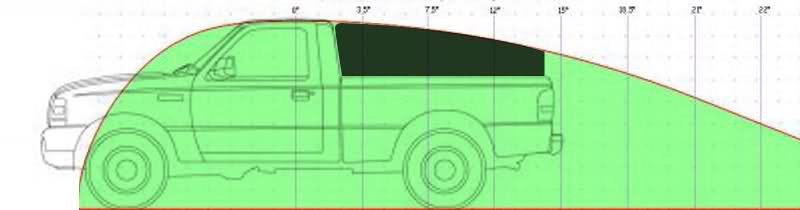
The goal is aero-mods is to make a vehicle as close to a teardrop shape as possible.


And while many car designs typically match this shape better than an open bed pick-up truck,

the large bed area (with no particular requirements for headroom) leave a lot of room for modding a cap to make it fit the shape even better:


The result is referred to as an “aerocap” or “aeroshell”, and it can potentially give a truck lower air drag than some cars, while providing a covered and secure space to store cargo.

Of course none of this is news to serious ecomodders, and a large number of varying designs have been built, with different solutions to balance the trade-offs of maximum aerodynamics, interior space and accessibility, rear visibility, being securely attached but easily removable (in case on needing to use the truck bed for large items), and looking seamless and integrated.
Here are some of the designs that have been showcased in the ecomodder forums:

AeroHead / ITworks / Phil Knox’s T-100
Inline image 1
One of the very first.  Phil has been aeromodding since the oil embargo of the 1970′s.  This particular truck was in the form in the picture in 2005.
Measured coefficient of drag on the stock truck, plus aeroshell: 0.325
For reference, an open bed pick up has a cd around 0.40 to 0.45, a typical car 0.30 to 0.35, and the original Honda Insight had a Cd of 0.25, the lowest of any standard production car.
The lower the number, the less air resistance.
With all of the mods shown in the picture, coefficient of drag dropped all the way to: 0.25
The shell alone caused a 13% highway mileage improvement compared to the same truck at the same speed without it, 27.5 miles per gallon (EPA 25), and with all aeromods it got 32mpg at 70mph.
For more on this truck, see: http://www.evworld.com/article.cfm?storyid=870

AeroHead / ITworks / Phil Knox’s T-100: V2
Inline image 7 Inline image 2
Inline image 3 Inline image 4
The original aeroshell was partially eaten by goats (or something like that…)
So he started over, and built another, goat-proof shell, and, as heavily aero-moddified as the first version was, he took the new one even further.
The new shell is made from the hull of a sailboat – you can tell in the first picture, the others are the same, just painted, and later with a window which removes the passenger side blind spot.
Aerohead takes this to Bonneville for racing and setting records and such, so the priority is maximizing aerodynamics over cargo carrying utility (the shell is removable though, so the truck could be used like a truck).
Theoretical Cd of 0.156
almost 80% mpg improvement compared to an original unmodified T-100, at 36mpg highway!
And yet still this was not enough – he has also built a trailer that attaches to the back of the truck just to extend the aerodynamic taper even further!
Inline image 5
Wow.  Just wow.
A labor of love with years and years of labor put into it.
For more on this absolutely magnificent monstrosity, see:
http://ecomodder.com/forum/showthread.php/pickup-truck-streamlining-14884.html
http://ecomodder.com/forum/showthread.php/basjoosing-toyota-t-100-articulated-front-wheel-skirts-22971.html
and
http://ecomodder.com/forum/showthread.php/full-boat-tail-trailer-gap-fillers-toyota-t-7839.html

Bondo / Brett Herndon’s Aerolid
Inline image 8 Inline image 9
Ok, so the ITworks T-100 may be a little too extreme for the average pick-up truck owner.
On the other end of the spectrum of customization and labor required by the end user is the very polished and professional looking “Aerolid”.
These are available for purchase.
The long term goal is funding for large scale commercial availability (patent pending), but even without corporate sponsorship, he has already produced several on his own, and has a website up for their sale.
Highway mileage increase (on this truck) of over 20% 18mpg to 22.
For times the truck needs to be used for serious truck stuff, the center section can be removed without removing the entire shell
Inline image 10
If a load is just a little too big to fit under the shell, but not so big it has to be removed entirely, it is hinged and can swing up partially; also making it a potential place to hang out while camping.
Inline image 11 Inline image 12
For more interior space and even better aerodynamics, there is an optional extender kit that is deployed with the tailgate down, which can fold away when not in use
Inline image 13 Inline image 14
Inline image 15 Inline image 16
For more on the Aerolid, see his website:  http://www.aerolid.com/
or the ecomodder thread http://ecomodder.com/forum/showthread.php/commercially-produced-aerodynamic-pickup-bed-cap-583.html


In between those two extremes the DIYers at Ecomodder have come up with plenty of unique designs:


SkyKing’s aeroshell/boat tail for the Dodge truck “Woody”

Inline image 17
Made from laminated plywood sheets on a plywood frame, this design goes further and lower than any other.
26mpg highway from an otherwise unmoddified (except those beautiful wood side boxes) 1-ton.
For more on Woody’s shell, see:  http://ecomodder.com/forum/showthread.php/testing-aeroshell-boat-tail-dodge-22354.html


T Vago’s
compound curve foam board pickup aeroshell


Inline image 18 Inline image 19
10% improvement, from 19mpg to 21mpg with no other mods.
Its made of foam, so its very light; which is good, sense adding weight reduces fuel economy, which would be counter-productive.  Also, it makes it easier to take off when the bed space is needed for big bulky stuff.
You can read much about its design process on a previous blog post:  http://ecomodder.com/blog/makings-pickup-aerocap-vagos-dakota/
as well as the forum thread http://ecomodder.com/forum/showthread.php/t_vagos-compound-curve-foam-board-pickup-aeroshell-15862.html


BamZipPow’s T-100 Aerocap


Inline image 20
Made from coroplast (plastic sheets) over wood and metal frame.
Up to 27mpg highway.
Long thread covering everything from concept to construction to V2 trials:
http://ecomodder.com/forum/showthread.php/another-truck-aero-cap-idea-15137.html


JRMichler’s Nameless’ Canyon topper


Inline image 21 Inline image 22
Along with other mods, improved mileage from 21mpg to 30mpg in winter, and 27 to 35 in summer, with around 2mpg of that increase specifically upon replacement of the original non topper with this one.
Believe it or not, it is constructed of plain old plywood, waterproofed and strengthened with epoxy, and prettied up with some hardware store paint.
Details at http://ecomodder.com/forum/showthread.php/modding-06-gmc-canyon-17070.html


JRMichler’s brother’s Ford F-250


Inline image 23
Mileage of 23.5mpg, up from 19.5
Not a lot of information on it is public, but what there is is here:
http://ecomodder.com/forum/showthread.php/modding-02-ford-f250-16798.html


Bajascoob’s Lightweight Aerocap on BigWhiteWhale


Inline image 24 Inline image 25
In addition to being relatively light, this design neatly solves the issue of reduced visibility created by every single other aerocap design.  The entire thing is completely translucent.
Unfortunately, plastic film isn’t 100% clear, so while he can see headlights behind at night, it isn’t clear enough to allow eliminating outside side mirrors.
Went from 16 to 19mpg.
Made of 1/2″ metal conduit frame wrapped in 4mm film, for a total of roughly $20 material cost.
More here: http://ecomodder.com/forum/showthread.php/f-250-7-3-4wd-light-aerocap-12573.html


Swede’s Aerolid


Inline image 26
Coroplast over a welded 1/2″ conduit metal frame.
13% improvement, from 20mpg to 23.
Read more:  http://ecomodder.com/forum/showthread.php/swedes-aerolid-build-thread-13092.html


Kevlar’s aero “Toyota truck”
(Apparently in 1992 Toyota didn’t give its trucks model names or numbers?)
Inline image 27 Inline image 28
Made of fiber-reinforced plastic board panels, the stuff public restroom stalls are made from.
31mpg actual, with an EPA estimate of only 24mpg highway
Since sold – and the new owner is reporting even better mileage, 32-36mpg.
http://ecomodder.com/forum/showthread.php/aero-truck-project-begins-2269.html


Ccrider’s Tacoma Aerocap


Inline image 30 Inline image 29
1/2″ Plywood on a wood frame.
$45 worth of material, including the paint.
30+ mpg in a truck rated for 20.
Simple, inexpensive, yet the numbers speak for themselves.
Build thread at: http://ecomodder.com/forum/showthread.php/aerocap-tacoma-pickup-11271.html


Jacob Aziza’s Big Orange Work Truck’s tilted tonneau

(That’s me, the author)

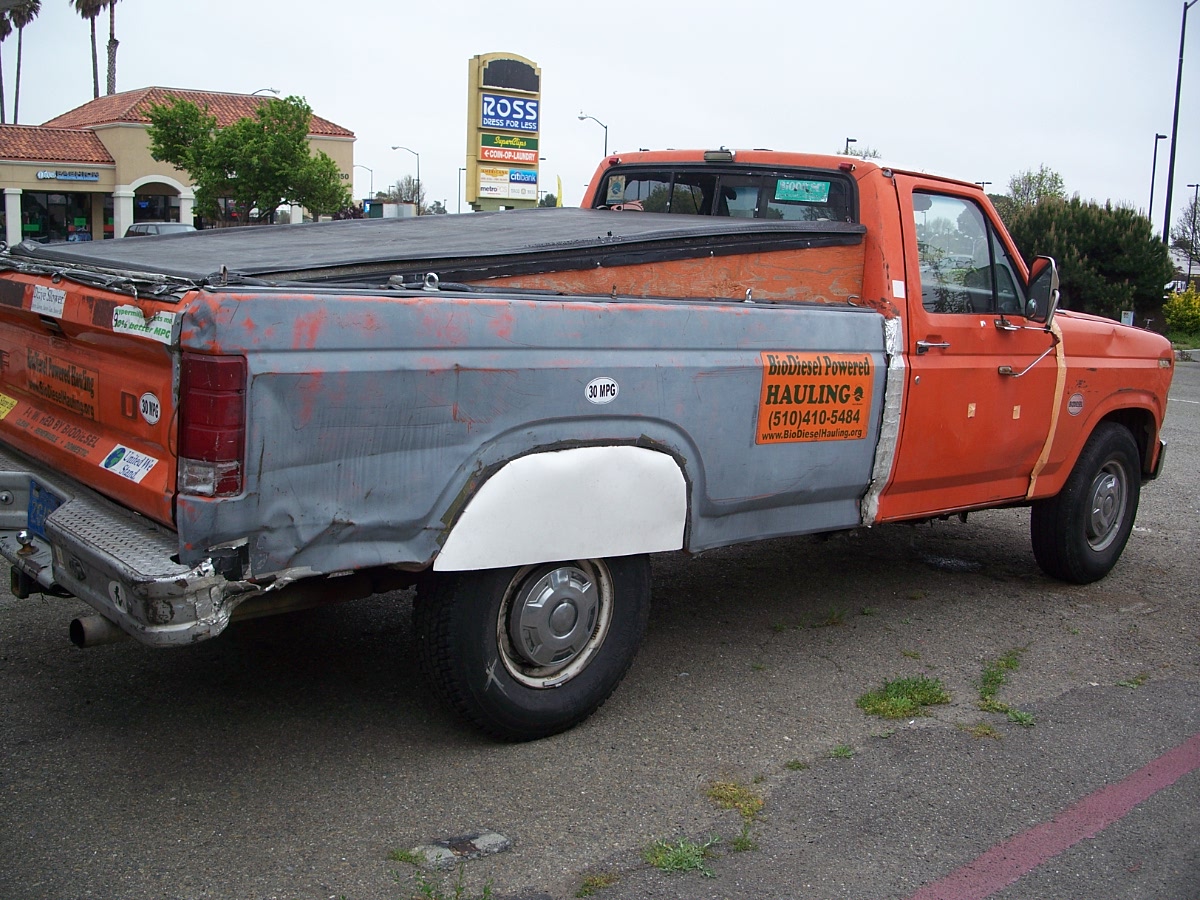
Mine represents the opposite extreme from the first truck in this list, the ITworks T-100 in the trade-off between aerodynamics and the ability to use the truck bed.
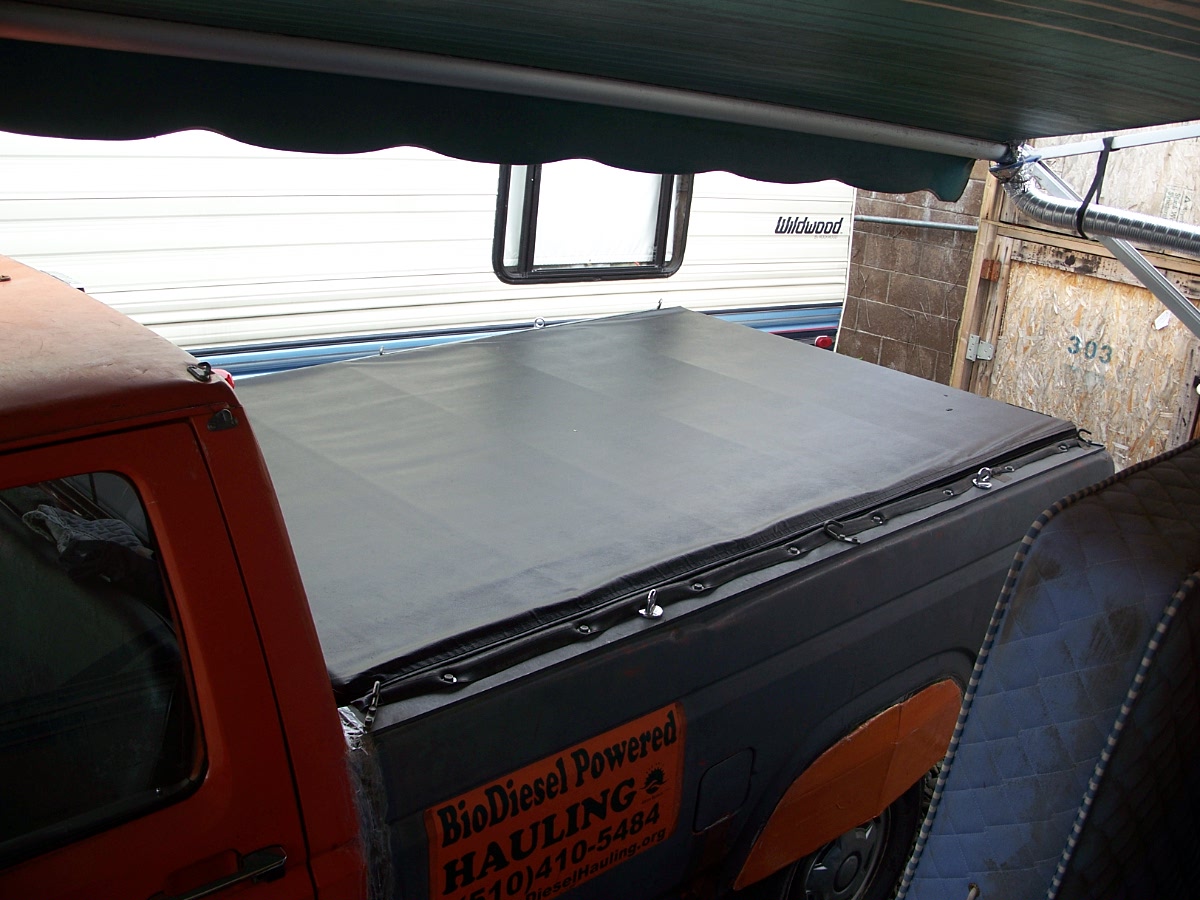
Unlike every other design, the cover does not actually start at the roofline.  From an aerodynamic perspective this is a pretty major design flaw – it means that the air flowing off the back of the roof will not continue on smoothly to the cover, but will actually separate, leaving an air space of slower moving and potentially turbulent air right behind the rear window.
I was aware of this when I built it, but I decided it was more important to have a fully unobstructed view to the rear.  I regularly drive this truck in dense city traffic, at lower than normal speeds on major highways, and have to back up down driveways so narrow that I have to fold both side mirrors in.  In other words, I use my rear-view mirror a lot.  And even without a cover, I managed to back-up into a parked motor scooter once.  So I decided to sacrifice optimum aerodynamics and have the bed cover start about midway between the top of the bed and the roof.  I have a rearview mirror mounted just below the ceiling inside, and being higher than the top of the cover means I can see over it right to the edge of the tailgate.  I actually have a better view to the rear than with the stock mirror set up.

My other consideration that required a major trade off in maximum efficiency for maximum utility is that I regularly use the truck to haul things which would not fit under any of the above aerocaps, even the hinged ones if they were at maximum tilt angle.


Some of the aerocap designs have removable tops, or remove relatively easily for those times, but those times are so frequent for me that it would be extremely inconvenient to have to be constantly removing and replacing a cover. Besides for which, living in an RV, I have nowhere to store a large aeroshell when not in use.
Most of the time my trip goes something like: travel to location with bed empty, pick up bulky stuff, transport it to somewhere else, travel home with bed empty.  So if I was going to do anything to make the truck bed more aerodynamic, it had to be something I could remove completely within seconds while in the field, store it out of the way on the truck, and then deploy it again just as quickly for the trip home.
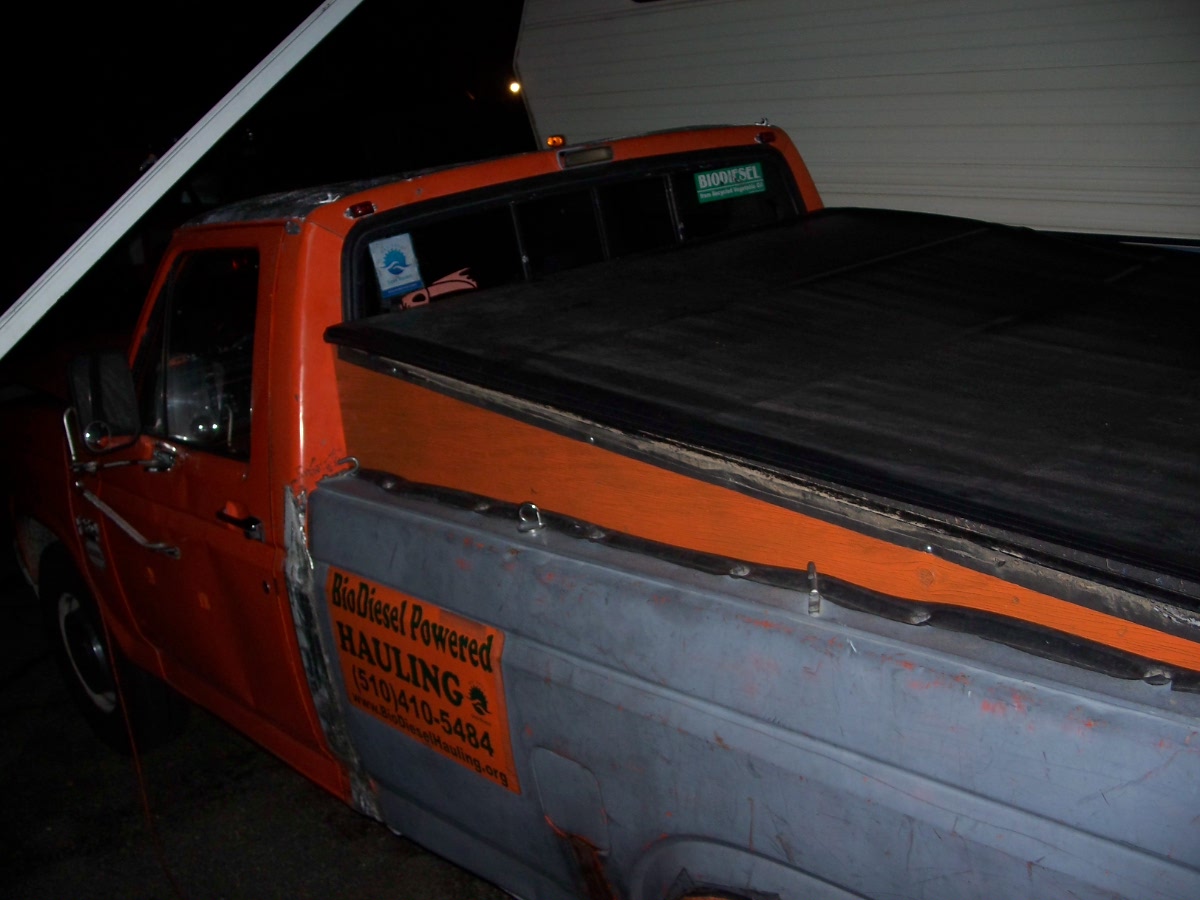
My solution was to take a standard, commercially available roll-up vinyl tonneau cover, and mount it on triangular plywood sheets.  When I need to access the bed, I just roll it up.  If the bed is empty (or carrying little enough) I roll it down, and the built-in rails keep it locked down.  While not the ideal angle, it still lets the air coming off the roof travel down to the tailgate level more gradually.
Vinyl tonneau with metal stabilizers on metal rails attached to plywood sides.
I already owned the tonneau (originally cost about $180), and used some old plywood and bolts I had lying around, for an additional cost of $0
My overall average mileage (on an already heavily modded truck) increased from 26mpg to 28, and test-run highway mileage from 28mpg to 30.
A lower improvement than many of the other designs – no doubt due to not starting at the top of the roofline – but an improvement none the less, and not too far behind most of the other numbers when reporting an actual before and after (as opposed to comparing with the EPA numbers – after all, the expected mileage for my truck is around 15mpg)


There are surely more that I have missed.  Hopefully there will be plenty more to come.
Its always best to buy the smallest vehicle that will fit your daily needs, (and rent a truck if you only need one every now and then).
But for those few people who legitimately do need a big truck, there is no reason to resign yourself to terrible fuel mileage.  If ecomodders can get hybrid like mileage out of ordinary cars, we should be able to get at least ordinary-car-like mileage out of big trucks.
If you’ve been inspired to improve your own truck, post on the forum with your thoughts and questions.  There are a lot of helpful knowledgeable people who will be more than happy to give you any advice you may need to do a similar project of your own.

Update: Oct. 25, 2012 …
For even more examples of aerocaps in the EcoModder forum, see: http://ecomodder.com/forum/showthread.php/comprehensive-list-aerodynamic-pickup-caps-aeroshells-ecomodder-elsewhere-23775.html

Friday, 13 July 2012

Prius C: A sub-compact hybrid, at a non-hybrid price.

Prius C: A sub-compact hybrid, at a non-hybrid price.

by Bakari Kafele on July 13, 2012

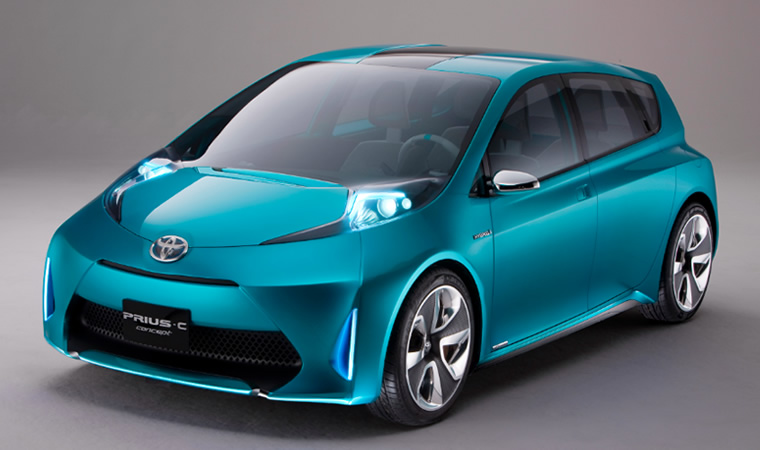
The newest Prius, available for only 2 months now in the US, is a compact fuel-efficient hybrid.
One thing it is not, however, is a Prius.


The car is really a Yaris hybrid.

But, given that “Prius” is basically synonymous with “hybrid” among average Americans, and that the Yaris may seen by some as an “econ-o-box,” it is a smart marketing move on Toyota’s part to label it as a Prius. (In its home country of Japan it isn’t called a Yaris hybrid either, its called the Aqua).
Despite the misnomer, both the pricetag and the size reflect its true roots as a Yaris.
Sticker, at just under $19,000 baseline, is over 20% less expensive – $5000 less – than the standard model. Of 337 different models available for sale in 2012, only 17 cars are cheaper – and none of them are hybrids.

The first time I was in the original Prius, I was shocked at just how large the interior felt. It almost seemed more like a small minivan than the “compact” car it was classified as. I guess this shouldn’t have been surprising given how most long-lasting models have been super-sized over time (the modern Honda Civic, for example, is an entire 3 feet longer than the original Civic) – but it was not that long after the debut of the first US hybrid, the Insight, and I had assumed the Prius would be a 4 passenger version of that tiny car.

Ever since, it has seemed rather odd to me that the vehicle with the best (standard) mileage for sale in the US is one which falls in the 4th highest of the 5 size ratings. Surely, I imagined, something with a Prius like drive-train, but in a mini or compact size, should be able to get even better mileage.
It took them 12 years to do it, but the “Prius” C is just that.

It is over 1 1/2 feet smaller, 2 inches thinner, and almost 2 inches shorter than the original Prius, as well as 500lbs lighter – it’s actually lighter than many non-hybrid compact cars, such as the Fit, the Miata, and the new “Mini” Cooper.

The ‘C’ in the name stands for ‘City,’ where the small size would make parking easier and the lighter weight will help fuel mileage. As it does, at least in city traffic, where its meant to be used. By US EPA standards it gets 53mpg city, the highest rating of any (non-electric/plug-in) mass-produced commercially available highway capable auto in the country. At the same time, the EPA gives it 46mpg highway, slightly worse than the original Prius, and the two average out to a mixed rating of… 50mpg, exactly the same as the original Prius. However, it is very interesting to note that – although the marketing department is limited by law to only advertising the EPA generated numbers – Toyota’s own engineers estimate the mileage at a whopping 82mpg(US) under Japan’s mileage testing system. One tester even got 57mpg on the excessively hilly streets of San Francisco, so the official ratings are clearly conservative. Even a lead-footed car-guy tester with Car and Driver beat EPA with 55mpg on his test run.

Some of the reviews coming from professional car reviewers are pretty much what you would expect before even looking at them: this is a nice car – looks good, comfortable though small inside, handles decently, lots of technology and gadgets – but it doesn’t have enough acceleration. Its 0-60 is around 11 seconds. This apparently feels like driving through syrup to someone who is used to reviewing modern overpowered passenger cars, but for comparisons sake, a semi-tractor-trailer measures its 0-60 time in minutes or miles, and they are apparently capable of merging onto freeway onramps somehow. The more a particular reviewer is able to shift their frame of reference from performance to fuel economy, the more they liked it.

Bonus: everyone agrees that its 25-40mph acceleration of 3.6seconds – more what you’d use in city driving – is plenty.

Apparently consumer’s minds are coming around. Despite its small size and <100hp 10="" 2012.="" 2012="" 337="" 3="" 3rd="" 4="" 5000="" all="" and="" any="" aqua="" are="" as="" at="" award.="" been="" between="" by="" c="" can="" car.="" car="" cars="" combined="" compact="" countries="" deathtraps="" demand="" dying="" earn="" fact="" faster="" fastest="" first="" for="" have="" helped="" higher="" highway="" in="" institute="" insurance="" is="" it="" its="" japanese="" just="" keep="" literally="" minivan="" models="" month="" most="" much="" myth="" new="" of="" one="" only="" op="" original="" out="" over="" p="" part="" perhaps="" pick="" plug-in="" popular="" pre-orders="" prius="" produce="" production.="" projected="" rii="" riuses="" s="" safety="" same="" selling="" slowly="" small="" sold="" than="" that="" the="" them.="" they="" three="" time="" times="" to="" toyota="" two="" units="" up="" v="" was="" with="" world.="">
Then again, even though it is smaller than its predecessor, it isn’t really that tiny. While it is 1.5 feet less in front to back length than the original Prius, it is still a full 3 feet longer than the Scion iQ, another city car made by Toyota, which (unlike the Smart Car) has room for 4 passengers. The last 2 passengers might not be in luxury, but the reality is that most people, most of the time, don’t have 4 adults in the car. They have one, maybe 2, and possibly one or two children. So the iQ would probably be an appropriate size for many, if not most, households – especially if it’s the second of two cars. Of course the iQ gets nowhere near the C’s mileage (36/37), it is also $3,000 less.

I guess I will just have to keep waiting for a car to come out with the size of the iQ but the mileage of the Prius C. They are heading in that direction.

If one was going to get a new car now, the Prius C is the most efficient car out there, at a pretty reasonable price. In a decade or two, when used ones can be found on Craigslist for a few thousand, I might just pick one up myself. In the meantime, hopefully an ecomodder with a bigger bank account than mine will pick one up. I’d love to see what could be done with it in the right hands.

Wednesday, 2 May 2012

Jacob Aziza / Bakari Kafele; Ecomodder / Hypermiler

Jacob Aziza / Bakari Kafele; Ecomodder / Hypermiler

by Bakari Kafele on May 2, 2012
Good morning fellow ecomodders, hypermilers, and efficiency enthusiasts of all kinds.
The EcoModder blog has been inactive for over a year (save Tim’s two most recent updates), and I have been asked to help pick it up again.
So, since I also have not been active on this site for nearly a year, to start I thought I would re-introduce my self:
My name is Bakari Kafele.  My internet screen name (or at least one of them) is Jacob Aziza.
You may remember me from such internet sites as the EcoModder Forum and Instructables.com
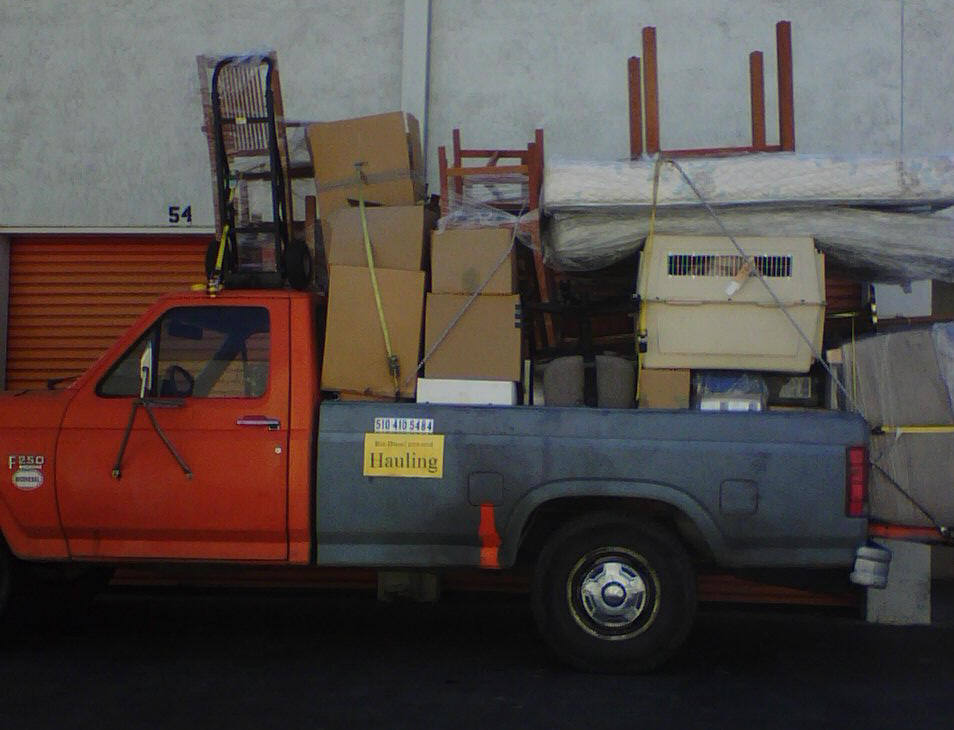
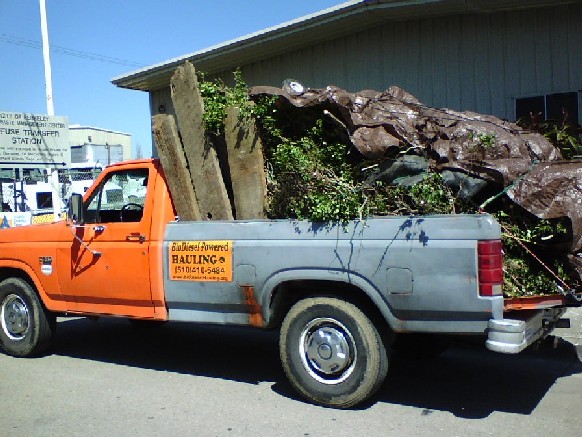
I have an old (1983) full-size truck with a 6.9L diesel V8 that I use for deliveries and hauling and occasionally towing.  It would be a monstrosity for a commuter vehicle, but it’s about the smallest thing that could serve my work needs – most people hauling large or heavy loads (see below) would use a box truck, a flat bed, or maybe even a dump truck.


At the very least an F-350 or equivalent1-ton pick-up.
So, depending on how you look at it, getting 15 miles per gallon, (as I was five years ago), could be considered decent, given the type of work being asked of this old truck – 15 mpg being what I measured I was getting, which coincided more or less with what most people report getting in the same make model and year truck.
Then, in 2008, I read an article about Wayne Gerdes…


I found it to be revolutionary and inspirational.  It was one of those moments where it seemed like the idea should have been glaringly obvious all along, and yet somehow never occurred to me.  Slow down, accelerate with moderation, coast early instead of braking last minute.  Obvious stuff, right?
While I had always been environmentally conscious (I was running the truck on biodiesel most of the time,  and my personal transportation was – and is – mostly done by bicycle), I had also been a speed enthusiast in my youth.  The only reason I gave up on casual street racing, drifting, and other performance and trick driving in my Honda Civic was that I totaled it when I attempted to take a tight turn (the sign recommended 20MPH) at 55MPH.
I never put two and two together; never recognized the direct correlation between driving habits and resource consumption.
After reading the article, my driving habits underwent a 180 degree turn.
Despite having once received a letter from the DMV warning me that I was one point away from a suspended license, I now started driving below the speed limit, anticipating stops, and even coasting.
And after a few months, I was pulled over by the CA Highway Patrol once again.
Not that driving 50MPH on a 65MPH highway is actually illegal in CA; but because EVERYONE speeds here, all the time, the officer assumed I must be intoxicated to actually drive below the speed limit.  When I passed the breathalyzer, I was free to go.
I found that to be a (tragically) funny thing – I am surrounded by people breaking the law.  I am the one person NOT breaking the law.  And I am the one who gets stopped by law enforcement, because it is suspicious that I am not breaking the law like everyone else.  I thought that would be an interesting story to share, especially with people who were also trying to get the best possible fuel mileage from their own vehicles.
So I went online, and tried to find out if there were any discussion boards specifically dedicated to this “hypermiling” thing.
And that’s how I discovered:  EcoModder.com
Wow.  A whole new level.  Not only were there dozens of more in-depth secrets to driving technique, but people were actually modding their cars – not to make them faster or look cooler – but to actually make them more efficient.  Revolutionary, mind-blowing, and in the end as it turned out, life changing.
I won’t chronicle the entire process here, because I already did in the forums, as it was happening.
During this process a friend of mine (and fellow mechanic at the bikeshop I work at) convinced me to write about my truck mods for Instructables.com.
They happened to be doing an energy efficiency contest at the time, which I entered and took second place in, winning a T-shirt!
But even better, the founder and CEO of the company noticed my contest entry, and personally hired me to do a little work at his home.  How cool is that?
Throughout this time period, I had also been writing my own personal blog, and one of the founders of faircompanies.com, Kirsten Dirksen, happened to run across my article on anthropogenic global warming, in which I argue that the evidence is still inconclusive, but we should be acting as though it is true regardless of what science eventually finds.  She asked if I would post some of my content on their website, which I began doing.
About a year or so later she emailed me saying they were taking a trip to the US (from Spain) and asking if I would be willing to be interviewed on camera.
I was still new to hypermiling and hadn’t started ecomodding when the video was taken, so while I did mention driving the smallest vehicle that meets ones needs, fuel efficiency, and bicycles, the portion on my small home got most of the attention.
As my ecomodding habit began, since I was already posting eco related content to the Faircompanies website, Kirsten followed the development of the truck, and its transition from 15mpg to up to 30mpg. The next time she came to the US, several years later, she requested a follow up interview – and the new video which came out recently is all about hypermiling and ecomodding.

That brings us to today.
I recently looked into replacing the rear differential, as was suggested to me in the forums, but it turns out the 2.73  and 3.08 were never made for the stronger 8 lug / F-250+ wheels.  So I’m back to wanting to replace the transmission with one that has overdrive to lower my highway RPMs, but I haven’t found a diesel ZF with the granny gear yet.
I’ve been getting slightly lower mileage than my peak, just over 25 miles per gallon over the past 6 months, VS 29MPG average over the 6 months before that – but still a whole lot better than the 15MPG I started out at.
Inline image 1
I suspect this is mostly due to having re-installed the alternator after my onboard 120v charger died, and being lazy about pulse and glide (as in, not doing it at all).
Between the video coming out and writing here, I’ve been more motivated to get my mpgs back up.
I’ll let you know how that goes.
UPDATE – I recently replaced all four tires with the General Grabber HTS, which is one of only two brands that is supposedly low rolling resistance in a tire with a 120 load rating.  I have only had them on about a week, so its too soon to say if/how much they will help (they are replacing on/off road tires in back, and dangerously worn road tires in front) – but what I can say is that the first time I drove with them fully inflated (the shop of course only inflated to 50 – even though I specifically asked them to go to the sidewall max of 80PSI) it was so easy to turn the (manual) steering wheel that for a split second I actually thought there might be something wrong.  I had gotten used to the old tires, and these ones turn with so little resistance that it feels like power assist by comparison.  That feels like a good sign to me.
I also just received my new battery charger (yesterday!) so I can take the alternator belt back off.  Between the two, I’m hoping to hit my 5th 30+mpg tank average – and then keep it there.  We’ll see…

Sunday, 18 March 2012

"Mad Max" hypermiler questions and comments answered


As I am very sure that anyone who has found this blog is already aware, me and my work truck were recently featured on  TreeHugger, Huffington Post, HighT3CH, and Faircompanies.com, among others, for my new video (shot, edited, and posted to Youtube by Faircompanies' Kirsten Dirksen)

It is 14 minutes long, which is long by modern internet video standards, but still was only enough time to provide a little snapshot into the entire concept.
I've been crawling the web for the various re-posts and the comments on them.  Not surprisingly, given how unorthodox everything I'm doing is and how unfamiliar the general public is with the idea of hypermiling, there are a lot of questions and criticisms and misconceptions.
First, I'm not in or from LA.  I live in the San Francisco Bay Area.

Also, the grill block is not made of concrete!! :P
That error is just bizarre.  I wrote to treehugger's editor about it, but I haven't heard back yet...
[update: he wrote back, and fixed it]


Some of the more common questions and comments I have noticed follow:


Why don't you just use a smaller truck (or, "I get better mileage than that in my compact truck")?

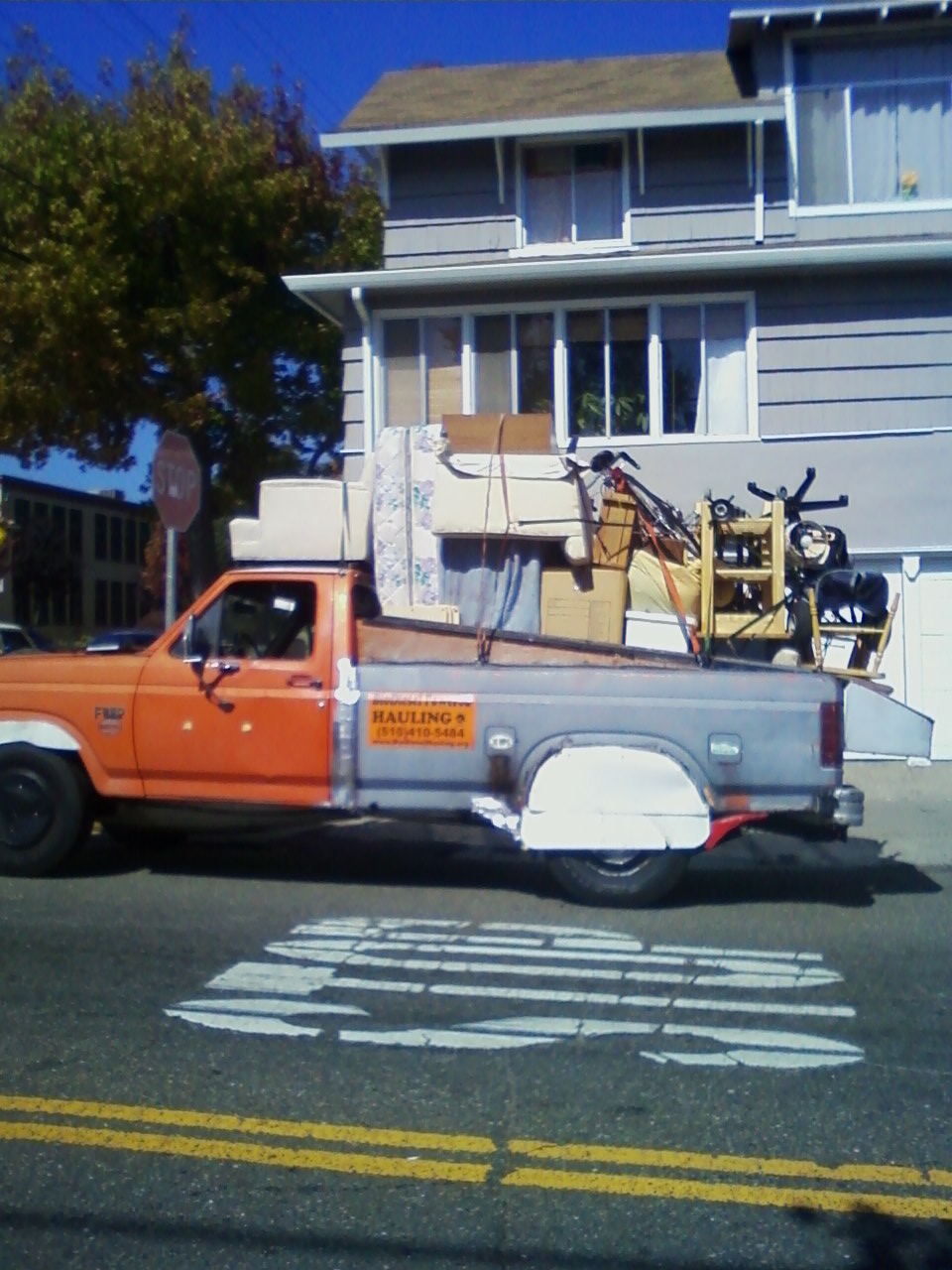
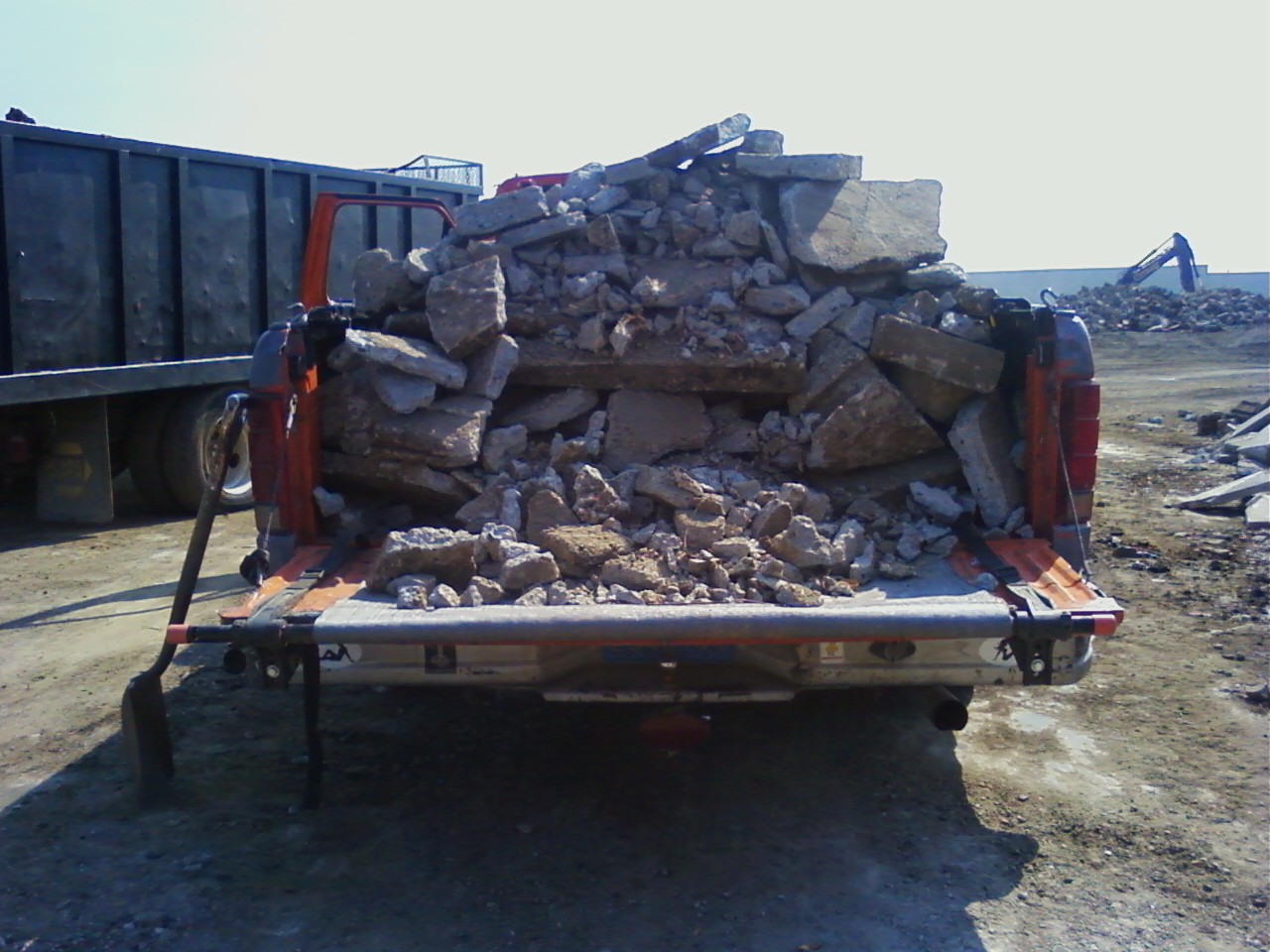
What you see in that video is just one random day.  On other days I have to move a couple tons of soil or concrete, or the entire contents of a 1-bedroom apartment including furniture:


I recently had to move an original painting that was 5ft x 8ft.  Being able to lay it down flat with the cover on allowed me to transport it safe, clean, dry, and out of the wind and direct sunlight from the artist's home to the gallery.  Monday I will be needing to get several full size sheets of plywood, which can only lie flat in a full bed.
While most would put loads this size into a box truck or a flat bed, or even a dump truck, I am using a 170HP full-size pick-up. 
When you look at it this way, my truck could be considered small.

Of course, if you aren't a hauler, there is no reason you should be driving a full size truck.
Everyone should use the absolutely smallest vehicle that meets their needs.  For the majority of Americans that probably means a compact car, or even a motorcycle.

The point of the video isn't the specific number "30".  The point is that it is 15mpg better than when I started.  The same can be done with any vehicle.  If you are currently getting 30mpg, apply the same ideas and you could be getting 45.  If you drive a Prius, you should be getting at least 70.  But since most Prius drivers drive like regular Americans, the real world reported mileage is closer to 45.

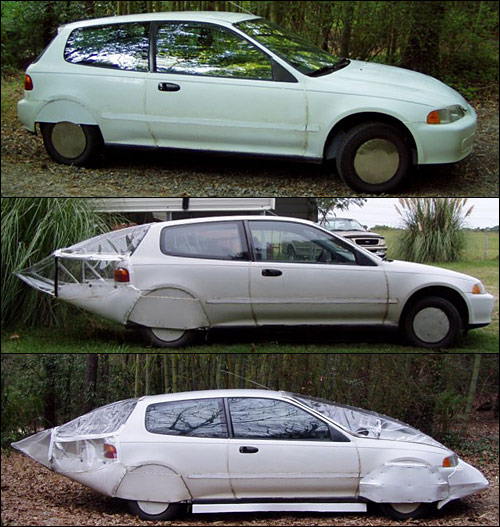
The best example of the same ideas applied to a small car is the Aerocivic


100+mpg in a regular old, non-hybrid car with no special engine technology.


Doesn't it take more fuel to start than it does to idle?
No.
No it doesn't.

That is an incredibly common misconception, that was started back before fuel injection and computer controlled engines were invented.  Even back then, it was likely only true for idling under 45-60 seconds, especially if the engine wasn't warm yet.  It certainly was never true for idling 5 minutes while you wait for the person you are picking up to come downstairs, or even at a 2 minute long stoplight.

In a modern car, if you are at a stand still for more than 10 seconds, you are wasting more fuel by idling than it takes to start the car again.

http://www.iwilltry.org/b/projects/how-many-seconds-of-idling-is-equivalent-to-starting-your-engine/
(note that the number 10 is very generously rounded up from 0.2 seconds!)

Another example: http://ecomodder.com/forum/showthread.php/fuel-used-idling-vs-restarting-5144.html

The moral of the story is this:  NEVER IDLE.  You are getting 0 mpg.  You are not getting anywhere any faster.
It is about the same as taking a dollar bill out of your pocket and lighting it on fire.
Both in that it wastes your money, and that it causes unnecessary pollution.

Do not start your car until after you are fully settled, seat belt is on, foot on the brake, and you are ready to put it in gear and go.
Modern cars do not need to warm up.  There is literally no benefit to warming up a car before you start driving.
If you have to wait for someone to run in the store "real quick", turn off the engine.  If you know that the stop light you are at is extra long, shut the engine.  While you are waiting in the drive-through, shut the engine...
Actually, no! Just park, and get out!  Seriously, how lazy can we get?  It's a few feet to walk from the parking lot to the door. You get at least a tiny bit of exercise to burn off what you are about to eat.  And you'll get your food faster, because the line at the drive-through is longer than the line inside.  But I digress...


You are going to wear out your starter / clutch
Maybe, eventually...

First, it takes much less force to start the engine once it is already warm than it did first thing in the morning.

Second, if done correctly, bump starting uses very little clutch (and no starter).
The trick is a technique called double clutching - very similar to the technique used by semi-truck and race-car drivers.  Basically, when used in hypermiling, you shift into the highest gear and very briefly 'tap' the clutch up until it just barely engages, and then immediately depress it again.  Instead of fully engaging the engine with the wheels, you just 'bump' the engine a partial turn.  When the engine is warm, this is enough to re-start it.  Once it starts you step on the accelerator enough to match the engine RPMs to the transmission RPMs, and when they match (or close to it) you then release the clutch again.  This entire process takes place in about a second.  If you look closely, you can see me doing it at 5:02 in the video.

It may be that in the long run the clutch and/or starter lasts a few months less than they would have otherwise. 
If you buy a replacement starter from an auto parts store, they come with a lifetime warranty.
I've had to replace a couple (long before I started shutting the engine to save fuel), and all you do is walk in with a faulty starter, tell them your phone number (because I had lost the receipt but they keep records in the computer) and walk out with a new starter (also with the same lifetime warranty.)
So for the cost of replacing the starter just once you get a lifetime of starting it at every stoplight.
As far as the environmental impact, the starters you buy are refurbished, and the old one you turn in for the deposit is refurbished in turn.

Given that hypermiling saves hundreds or even thousands a year as well as preventing an equivalent amount of pollution, the occasional odd extra starter is more than worth it.


Accelerating takes more fuel than driving steady state, so why do you repeatedly accelerate and then coast - doesn't take that more fuel?
Accelerating does take more fuel than driving steady, and so that is an understandable confusion.
If car engines were 100% efficient, (or even remotely close to it) then the hypermiling technique, known as "pulse and glide" (P&G) would use more fuel than driving steady.

But engines are not 100% efficient.
The basic laws of physics dictate that no heat engine (which includes everything from gas and diesel engines to steam engines and coal power plants) can ever be 100% efficient.
No matter what technology produces in the future, any flammable fuel powered vehicle (including natural gas, biodiesel, anything that burns) will waste some of its energy on heat.

In a typical gas engine, efficiency is only around 25%.

In order to understand how much internal resistance is in a car engine, try this:
-Park on a perfectly flat area.  Make sure there are no parked cars, small children, or cliffs in front of you.
-Turn off the engine.
-Put the car in neutral and take off the parking brake. 
-Get out, and try to push the car.
You will be able to.  No matter how small you are, and how big the car is, you will be able to move it (albiet slowly) on flat ground in neutral.

-Now put the car into gear (engine still off)
-Get back out and try to push it again.
You will not be able to, no matter how big and strong you are. 

The difference you feel between the first try in neutral and the second in gear, that is the engine's resistance to turning.
Every time the engine is on, it has to overcome that internal friction with each and every rotation it makes - and it makes about 100 rotations every single second! 

In other words fully 75% of the energy in the fuel is used just to overcome internal resistance, to turn the engine itself. 
That's why it gets so hot (and why it needs a radiator).
75% of the money you spend on gas is not used to move you and your car around, it is used to make your engine hot.

On top of that, belt driven engine accessories and drivetrain losses absorb another 5-10% of the energy in the fuel.

That means all together, when the engine is running, well over 3/4 of the energy never even reaches the wheels.
And that is in optimal conditions, at the peak of the BSFC curve!*

Any time the engine is off, you are not wasting that 85%.

As noted earlier, accelerating takes more energy than steadystate driving, however, the internal losses don't change (a significant amount) in acceleration vs stead state.

So, if you can P&G with a 1:3 ratio (10 sec pulse, 30 sec glide) the engine is off 3/4 of the time. Over that 40 sec span, the 85% of potentially wasted fuel energy is conserved.
In order for that not to save fuel compared to stead state, it would have to require 4x more fuel to accelerate - and of course that is before even taking into account pumping losses or the fact that acceleration puts the engine in a more efficient part of the BSFC curve.

*(BSFC refers to the fact that an engine is more efficient at some speeds and loads than others. The peak is where you get the most torque for the least fuel, and what RPM and throttle position that corresponds to varies from one car to another, but it is always at least slightly more efficient during acceleration)

While coasting is more efficient in any car, it shouldn't be done in many cars.  Most cars with an automatic transmission should not coast at high speed or for large distances, as the engine circulates the transmission fluid that lubricates and cools the transmission.  Cars with a turbo charger should also be wary of turning the engine off during transit.  And of course, unless you have a very old car or have modified it, turning off the engine will change the steering feel and limit the number of power assisted stops (more on that later)


Driving slow is illegal

Driving excessively slow is illegal in some places.  Laws vary from state to state.  In my state it is not illegal to drive at 45mph on highways. 
I am not aware of any state which has minimum speed laws higher than 45mph.  In fact, the maximum speed for commercial trucks in my state is 55mph - only 10mph higher than the lowest speed I go. 
(Anything slower than that does not increase efficiency anyway, because it requires shifting to a lower gear, which raises engine RPM.  In most modern cars optimal speed is between 50 and 60mph, give or take.)

When there is a specific minimum limit, it is usually (but not always) marked:


In practice
its rare for drivers to drive below the maximum speed limit, but it is important to remember that the number on the sign is just that: a MAXIMUM.  It is not a requirement.  It is not even a recommendation.  And it is most certainly not a minimum.

If where you live there are highways that have a minimum speed of 50 or 55, I don't recommend driving slower than that.

For many vehicles, driving slower than that offers no benefit anyway.  Various factors determine the optimal speed for each vehicle; primarily how the transmission is geared, followed by how aerodynamic it is.  Optimal speed will usually be at whatever speed the transmission shifts into its higher gear (or the lowest RPMs in high gear without lugging, in the case of a manual).  For most modern cars this will be somewhere in the range of 45mph to 60mph. Unless you have a very old vehicle, its unlikely you will gain any benefit driving slower than that.


Driving slowly is dangerous

This misconception is almost as common as the myth that it takes more fuel to start than it does to idle.
And like that one, it is understandable how it got started:
Some traffic studies have found an increased accident rate for drivers driving below the average speed of drivers around them.

But here is the really important part:
Studies have also found that the rate of accidents that involve INJURY OR FATALITY goes down with a decrease in speed.

In other words, driving slow will increase the risk that you get a dent or scratch on your nice shiny car.  At the same time, it will also decrease the risk that you die in a fiery car crash!! 


So, given that there is a trade off, you have to ask yourself:  "which would I rather avoid: a dent - or losing a limb?"
Driving fast is the single biggest factor in injury and fatality accidents - more than drinking, more the cell phones, more than teenage drivers.  Speed has an exponentially bigger impact on accident severity than the weight of the vehicle.  In other words, driving 45 in a compact car is safer than driving 75 in a big SUV.
This is due to basic laws of physics, so it will never change, no matter what new safety features come out.
I could go on, but I already dedicated an entire blog entry to the topic, so if you are still unconvinced, you can see the math as well as the traffic study references there:
http://biodieselhauling.blogspot.com/2012/03/slow-down-my-philosophy-for-life-also.html

The fact that everyone around you is breaking the law, wasting gas, and endangering their lives, does not legally or morally obligate you to also break the law and endanger your own life to avoid inconveniencing them.  Even if every single other person on the highway is speeding, it is still all of them who are in the wrong.


You are interfering with traffic

Good hypermiling takes road and traffic conditions into account, and changes appropriately. 
In the video I am driving on a 4 lane highway with light traffic.  On a 4 lane highway there is no possible way for me to impede traffic.
I think this is common knowledge:  The left-most lane is considered the "fast" or "passing" lane.  The right-most lane is the "slow" or "merging" lane.  If you want to drive fast you should be in the fast-lane.
Kind of makes sense, right?
But the law says the maximum speed limit is 65mph (on most highways in my area, replace that number with whatever is your local limit).  That means the fastest car in the fast lane should be going 65mph.  That is the law.  I'm sorry, I don't make the rules. 
This means that every lane to the right of the left most lane should be going slower than 65mph, with the slowest traffic in the right most lane.
On a 4-lane highway, no one should be going significantly faster than me in the slow lane.
If they want to pass, they can change lanes.

In heavy traffic, hypermiling strategy changes.  I didn't happen to get stuck in any, so you don't see an example of it in my video, but someone else has made an excellent video with an example of how to drive efficiently in heavy traffic:


(click through to the original youtube page to see an excellent write up by wbeaty, the person in the video)

As you can see in this video, the act of driving efficiently actually makes traffic SMOOTHER for everyone behind you.  It is everyone else's erratic and aggressive driving which actually causes (or contributes to) the traffic jam in the first place.  If everyone drove this way, everyone would get where they were going much faster, much like walking in a calm single file line will get you out of a burning building faster than trying to shove everyone else aside. 

True, coasting to a stop light sometimes agitates drivers behind me who are used to driving full speed toward red lights and then hitting the brakes at the last moment.  But they would have had to come to a full stop anyway, so being "stuck" behind me is costing them zero seconds of time.  Do I feel bad for forcing them to save a little gas and help their brakes last longer?  I do not.


Isn't it illegal to turn the engine off while you are moving?

I might well ask you whether it is illegal to drive 66mph in a 65 zone, or to cross the street in the middle of a block with no crosswalk.
No, no, no, I'm not suggesting that this is a stupid and unenforceable law...
What I will say is that law varies from state to state.
In some states it is legal to coast in neutral, as long as the engine is on.
If you happen to live where that is the case, P&G is still beneficial, even if you coast while the engine is idleing (although not by as much).  (This is also important to note because automatics should not coast with the engine off at high speeds or for long distances)
In other states there is no rule about whether the engine is on or off, but you aren't supposed to be in neutral - but that doesn't mean you can't hold in the clutch while still leaving the transmission in gear.

What is perhaps even more important than the finer technicalities of the law is whether or not it is safe.
As noted earlier, by driving well below "normal" speeds (i.e. slightly above the legal lower limit) hypermiling is already much safer than regular driving.  In addition, to avoid having to brake, all hypermilers leave large following distances between them and the car ahead.  This, obviously, increases safety by a huge margin.
Finally, by being constantly aware of the road, conditions, and other vehicles around you, very little takes you by surprise.

There are no accidents.  There is only negligence. 

Regarding having the engine off specifically:  in most modern cars both the brakes and the steering are enhanced with help from the engine.
This is because Americans are incredibly lazy and spoiled.  I'm sorry.  I shouldn't rant.  Power steering just really bugs me.  I mean, really really really bugs me.  It is so stupid.  It is not hard to turn a steering wheel with a manual steering gear.  I mean, not even a little.  My first "car" was a 15ft long camper van with manual steering.  My current work truck has manual steering.  The ONLY time it is even slightly difficult is parallel parking.  Then it is some effort.  Nothing like running a 5k or bench pressing 100lbs, but it is more than no effort.  99.9% of the time behind the wheel is not spent parallel parking. 
So, in order to avoid having to put in a little bit of effort 0.1% of the time, car manufactures build in a complicated expensive system that sucks up 1-3mpg at all times.  It is hard to find a car, even an entry level model, that doesn't have power steering standard.  It is perhaps a reflection of us as a society that we are so fat and lazy that even after having had a gas engine do all the work of moving us from one place to another, we can't even be bothered to take the effort to turn a wheel in order to park the machine.
[end rant]

Where was I? 
Oh, right... shutting off the engine will take away the power steering.
The steering wheel will still work, but you will definitely feel the difference.
The best way to avoid that, (and improve your mpg at all times, any maybe even build a tiny bit of muscle during your daily drive), is to simply remove your power steering.  This is easier than you may think.  My girlfriend did it on her own, with basically no previous mechanical experience.** Basically you need to do just two things:
1) disconnect the lines from the pump goes to the steering axle, and
2) remove / replace the engine belt with one that bypasses the pump pulley. 

As far as the brakes go, there is a reservoir of brake boost, so after you cut the engine there is still brake assist for at least 1, usually 2 or 3, good hard brake pumps, enough for a panic stop in an emergency (which is less likely to happen if you are driving slow and have a good following distance, but its still better to have the option)

The last potential issue is turning the key too far, and locking the steering wheel.
I don't recommend turning the key one click too far and locking the wheel while moving.
In fact, I'm going to go ahead and word that a little more strongly:
Don't do that.
That would be bad.

All that is for a typical, unmodified car.
I have modded my truck specifically to accommodate engine off coasting.
My brake booster is electric.
My steering is manual (I actually installed a factory original manual steering gear, as it was optional equipment when it was sold - in other words, it is all OEM parts, although I personally did the downgrade)
I have an engine kill switch and starter on the gear shift column so I don't have to touch the key.

All of this means that all of the control systems function identically whether the engine is off or on, and therefor there is no increased risk from coasting.


**Specifically, she had done 1 oil change, and changed 1 flat tire before tackling the power steering delete project.


 Why don't you just buy something newer / better / hybrid / electric?

First of all, there are no hybrid or electric trucks available in the US that can handle the loads I move.

Second, newer vehicles are not significantly more efficient than old ones.
They SHOULD be, because engine technology has improved considerably, however those improvements have been used to make cars and trucks heavier, more powerful, and more feature rich.  My truck is powerful enough, and I don't need "features".

Third, my truck cost $2000.  I spent about another $800 on the mods.  And I ended up with a truck that gets better mileage than a brand new truck of comparable capacity would.  In fact, it gets better mpg than the average passenger car on US roads gets.

Fourth, by buying used I avoiding having additional mining and energy use in building and transporting another new vehicle.  Buying used is (almost) always easier on the environment than buying new, no matter how "green" the product or how "sustainable" the production process.

In the end, being environmentally responsible (contrary to popular belief) goes hand-in-hand with saving money.  Saving lots and lots of money.
Its win/win

------------------------------------------------------------------------------


I think that covers just about everything.
I'm not suggesting that everyone go out and do everything exactly the way I did.
But I do hope people will think twice about what things they can do differently.
Small changes taken by large numbers of people has a greater impact than big changes done by just a few people.  If you do nothing differently after reading this besides driving slower and never idleing, I will have made a bigger impact on the world by writing this than I have by all of my biodiesel-solar panel-vegetarianism ways ever could.
So help me out.
Help out the Earth and the country, and as a side-effect keep a little more money in your own pocket next time you head to the gas station.